
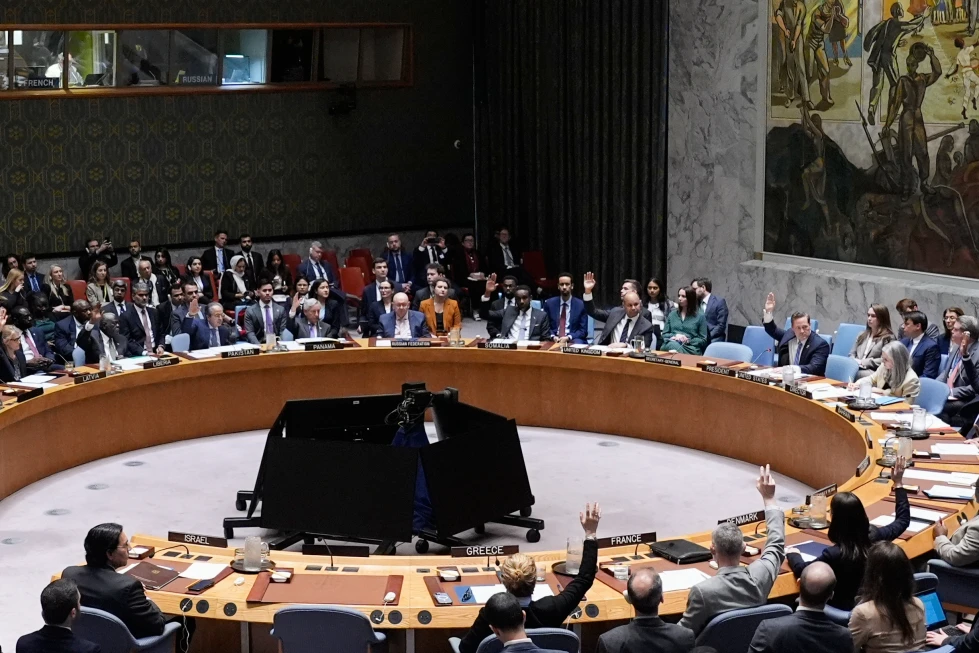
New York, 7 April 2026 – The United Nations Security Council convened in an effort to adopt a resolution that would allow action to keep the Strait of Hormuz open to shipping but Russia and China, two of the council’s 15 member states, voted against while 11 voted favor. The vetoes by the two countries nullified the vote by the majority of council members.
Russia, China, the United States, United Kingdom and France – the world’s most powerful countries – are permanent members of the 15-nation council while the 10 other countries are elected for two-year terms. The negative votes cast by any of the permanent members practically kill any resolutions adopted by the council.
The council’s failure to adopt the resolution introduced by Abdullatif bin Rashid al Zayani, Minister for Foreign Affairs of Bahrain and president of the council for April, took place just hours before the expiration of a deadline imposed by U.S. President Donald Trump who demanded that Iran reopen the strategic Strait of Hormuz or else a “whole civilization will die tonight.”
Countries that voted in favor of the resolution were: the US, UK, France, Denmark, Greece, Panama, Somalia, Bahrain, Democratic Republic of Congo, Latvia and Liberia. Pakistan and Colombia abstained.
“Failing to adopt this resolution sends the wrong signal to the world, the people of the world — a signal that threats to international waterways can pass without any decisive action by the international community,” the Bahraini minister said following the vote, pointing out that the council should shoulder its responsibility to ensure freedom of navigation in the Strait.
“We declare loud and clear, and unequivocally, that the Islamic Republic of Iran has no right to close this waterway to international navigation, nor to deprive the peoples of the world of these essential and vital resources,” he said.
“Will the international community accept being held hostage to economic attempts at blackmail regardless of the perpetrator?” he asked, stressing the text’s adoption today would send a strong, unified message – “that we uphold international law, that we will protect civilians.”
Abdullatif bin Rashid al Zayani said he acted also on behalf of the United Arab Emirates, Saudi Arabia, Qatar, Kuwait and Jordan and the resolution did not “create a new reality” but rather it was merely a response to Iran’s hostile behavior and to the very grave developments affecting the waterways most critical to international trade.
The failed resolution, which was proposed by Bahrain with full support of Gulf countries, demanded that Iran immediately cease all attacks against merchant and commercial vessels and any attempt to impede transit passage or freedom of navigation in the Strait and further calls for the cessation of attacks against civilian infrastructure, including water infrastructure and desalination plants, as well as oil and gas installations.
Until the war exploded on February 28 this year the Strait of Hormuz had been an important shipping corridor for tankers transporting large portion of crude oil, 29 per cent of liquefied gas, 19 per cent of liquid natural gas and 20 per cent of refined petroleum products to countries around the world.
US Ambassador Michael Waltz told the council following the failed vote: “The request from Bahrain and from the region was not unreasonable. They engaged every country on this Council and took their inputs and thoughts on board. It was a simple resolution: Iran must stop attacking the Gulf, stop threatening its neighbors, and reopen the Strait of Hormuz.
“And I would note, colleagues, that Russia and China might have chosen better partners than Iran. They might have chosen to stand with our Gulf allies—with Manama, with Doha, with Abu Dhabi, with Kuwait City, and others.
But instead, Russia has chosen to be a critical supplier of military equipment to Iran over the past year, in particular, delivering combat aircraft, helicopters, armored vehicles, and other arms to Iran, some of which violate Security Council Resolution 1929.
Meanwhile, China imports over 80% of Iran’s illicit oil—and Chinese entities have exported significant quantities of components intended for attack drones and technologies that could be used in ballistic missiles..”
Waltz said the US “stands firmly with our partners in the Middle East” and the Strait of Hormuz “is too vital to the world to be used as hostage, to be choked, to be weaponized by any one state.”
UN “deeply troubled” by US President Donald Trump’s statement on Iran civilization.
In response to questions about recent remarks made against Iran, the UN Spokesperson, Stéphane Dujarric, had the following to say:
“UN Secretary-General Antonio Guterres is deeply troubled by statements suggesting that entire civilian populations or civilizations may be made to bear the consequences of political and military decisions. There is no military objective that justifies the wholesale destruction of a society’s infrastructure or the deliberate infliction of suffering on civilian populations.
“The Secretary-General reiterates that conflicts end when leaders choose dialogue over destruction. That choice still exists. And it must be made — now. He calls for stepped-up diplomatic efforts to find a peaceful path forward. His Personal Envoy, Jean Arnault, is traveling to the region to support these efforts.
“Simultaneously, the Secretary-General appeals for freedom of navigation to be re-established in the Strait of Hormuz. As he said recently, when the Strait of Hormuz is strangled, the world’s poorest and most vulnerable cannot breathe.”
(By J. Tuyet Nguyen)
United Nations correspondent journalists – United Nations correspondent journalists – United Nations journalism articles – United Nations journalism articles – United Nations News – UNCA Awards