
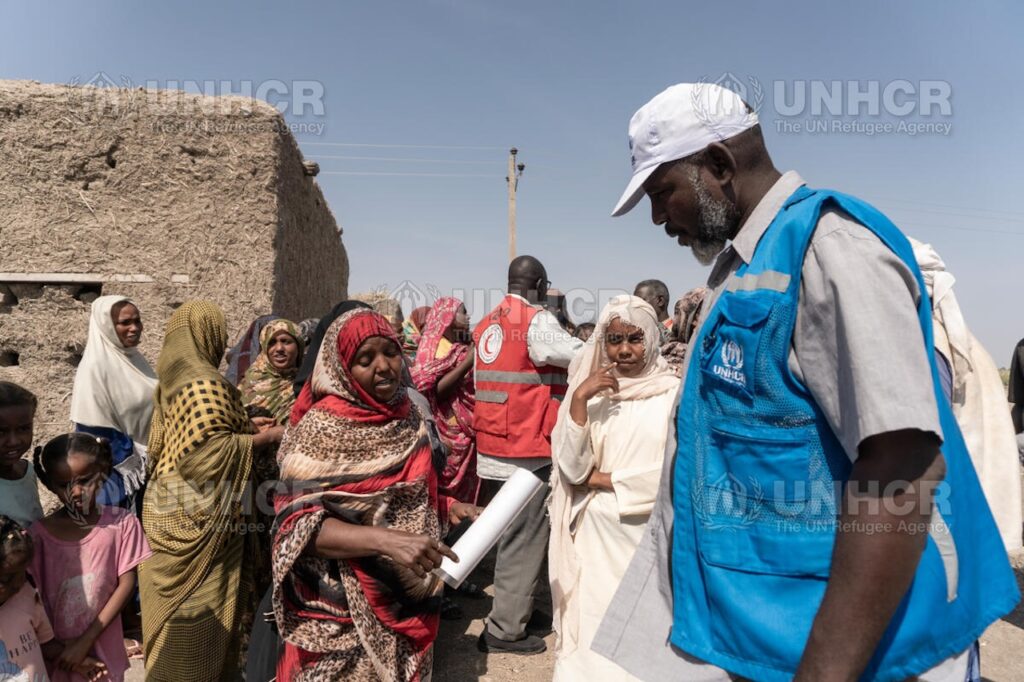
Note: Millions of Sudanese have been displaced by the war, which started in April 2023 and fighting is still raging in large parts of the country. The following is a briefing note to the press at the Palais des Nations in Geneva by Marie-Helene Verney, the representative of the UN Refugee Agency (UNHCR) in Sudan, on the current situation in that country.
Geneva, 10 April 2026 – As the crisis in Sudan moves into its fourth year, fighting still rages in large parts of the country, causing new displacement and extending the daily tragedy for millions of people with no clear end in sight.
Since the war started in April 2023, some 14 million people have been forced to flee, with 9 million remaining displaced inside Sudan and 4.4 million across borders. For many, displacement has been a repeated and exhausting cycle of flight to relative safety, only to flee again. Today, one in four Sudanese is displaced.
Violence is ongoing in much of Darfur, the Kordofans and Blue Nile State. Recent increased use of air bombardments and drones has sent more people fleeing. Human rights violations continue to occur, including conflict-related sexual violence, forced recruitment, arbitrary arrests, massacres and more. Civilians are particularly at risk, with frequent reports of harassment, violence and abductions taking place en route to safety.
Women and girls continue to face heightened risks of sexual violence, exploitation and abuse, particularly as they move through insecure areas. The collapse of health systems, law enforcement, and justice mechanisms has created a climate of widespread impunity. Survivors of gender-based violence face significant barriers to reporting incidents and accessing medical, psychosocial and legal services, further reinforcing the cycle of abuse and underreporting.
Millions of children have now spent three years of their childhood in displacement, with far-reaching consequences for their futures. Most have had little to no access to school. Over 58,000 children arrived alone in neighbouring countries, separated from their families in flight, often injured and deeply traumatized.
Neighbouring countries hosting the majority of Sudanese refugees – particularly Chad, Egypt and South Sudan – are at breaking point. Arrivals from Darfur into Chad continue, while South Sudan struggles to support Sudanese refugees and almost 1 million South Sudanese who have arrived since April 2023 amid its own growing crisis. Dwindling assistance and limited opportunities across all host countries leave many with impossible choices.
At the same time, many displaced Sudanese are returning to areas where fighting has largely abated. Some 80 per cent of these were internally displaced people, alongside 890,000 refugees from neighbouring countries. Most returns are to Al Jazeera and Sennar states, with almost 1.5 million returning to Khartoum, where conditions are dire; infrastructure and basic services have been largely destroyed, the economy shattered and the social fabric torn apart. It is crucial to support returnees to mitigate risks of further displacement.
There is also a growing number of Sudanese making the dangerous journey through Libya to Europe. Over 14,000 Sudanese arrived in Europe between 2024 and 2025, a 232 per cent increase since the conflict began. These movements are not driven by choice or convenience but as a response to the lack of prospects for peace, and unmet needs in Sudan and across borders. Peace, or at a minimum, better-funded humanitarian and development responses, are urgently needed to support Sudanese to live in dignity wherever they are.
Three years on, Sudan, the world’s largest displacement crisis and one of the worst protection emergencies, continues unfolding in the wake of a severe global funding crunch. Aid agencies, including UNHCR, the UN Refugee Agency, have so far received 16 per cent of the US$2.8 billion required to deliver assistance inside Sudan, and 6 per cent of US$1.6 billion for the regional refugee response.
Without renewed and sustained global attention and support, the suffering and risks will only grow for the millions displaced and for the wider region, making this crisis even more destabilizing and costly to resolve. A cost that Sudan, and the world, cannot afford to bear.
END
This Briefing Note is available here
For more information on this topic, please contact:
• In Sudan, Assadullah Nasrullah, nasrulla@unhcr.org, +249 912 178 991
• In Nairobi (regional), Faith Kasina, kasina@unhcr.org, +254 113 427 094
• In Dakar (regional), Fidelia Bohissou, bohissou@unhcr.org, +221 77 569 91 60
• In Amman (regional), Rula Amin, aminr@unhcr.org, +962 6 510 04 60
• In Geneva, Eujin Byun, byun@unhcr.org, +41 79 747 87 19
United Nations correspondent journalists – United Nations correspondent journalists – United Nations journalism articles – United Nations journalism articles – United Nations News – UNCA Awards