Note: Race to build EVs, renewable energy systems and AI infrastructure, with benefits flowing mainly to wealthy nations, is driving severe, largely hidden costs borne disproportionately by the poor in Africa and South America, UN University investigation reveals. unu.edu/inweh – Following is a News Release:
Richmond Hill, Ontario, Canada, 29 April 2026 – Mining critical minerals such as lithium and cobalt fuels the ‘green’ energy and digital transitions essential to meeting climate goals. But building the technologies that enable a sustainable future is generating severe, hidden environmental and health crises that the world is failing to track or address, warns a new report by the United Nations University Institute for Water, Environment and Health (UNU-INWEH), known as the UN’s Think Tank on Water.
The investigation finds that systemic global failures are allowing the costs of critical minerals extraction to fall disproportionately on some of the world’s most vulnerable communities, while the benefits accumulate elsewhere in the form of electric vehicles (EVs), renewable energy systems, and artificial intelligence (AI) infrastructure. Read the full report: https://bit.ly/4sNLgos
The report does not question the need for clean energy systems or the digital infrastructure underpinning them. Instead, it asks who is paying for and benefitting from humanity’s progress in those areas, and finds a deeply unjust answer.
“Technological disruptions are needed and useful. But we should be aware of and proactively address their unintended consequences if we want the whole world to equally benefit from them,” says UNU-INWEH Director Kaveh Madani, who led the investigation team. “You cannot call a transition green, sustainable, and just if it simply moves the environmental harm from the rich to the poor, and from one group of people or region to another.”
The report, Critical Minerals, Water Insecurity and Injustice, underlines the intense water requirements of critical minerals extraction and that communities living closest to mining operations are paying a steep price in contaminated water, water scarcity, lost livelihoods, and serious health consequences.
In 2024, the report says, global lithium output of roughly 240,000 tonnes consumed an estimated 456 billion litres of water, equivalent to the annual domestic water needs of 62 million people in sub-Saharan Africa, roughly the population of Tanzania.
In Chile’s Salar de Atacama, lithium mining alone accounts for up to 65% of regional water usage, intensifying competition with agriculture and domestic needs and driving dramatic groundwater depletion. Between 1990 and 2015, water tables in areas with brine wells dropped by up to nine metres.
And lithium mining in Bolivia’s Uyuni region is making it increasingly difficult for communities to grow quinoa, their economic and nutritional staple.
Globally, about one-sixth (16%) of critical minerals reserves are located in high water-stress regions, while 54% of energy transition minerals sit on or near indigenous territories.
The environmental damage extends well beyond water consumption. For every tonne of hard-to-extract rare earth minerals produced, approximately 2,000 tonnes of toxic waste are generated. In 2024, global rare earth production generated an estimated 707 million metric tonnes of toxic waste, enough to fill about 59 million garbage trucks – a number of trucks that could form a queue circling the equator 13 times.
The 21st century’s oil – The Paris Agreement gives urgency to the extraction of critical minerals to reduce the carbon-intensity of human activities. Yet this creates a new ‘paradox’: meeting global climate targets would require a ninefold increase in lithium demand and a doubling of cobalt and nickel demand by 2040.
“Without effective control mechanisms, the very targets designed to protect the planet can accelerate water, and health, and injustice crises in the communities least responsible for causing climate change,” says Prof. Madani, recently named the Stockholm Water Prize Laureate for 2026.
“The world is rushing to build a cleaner energy future, and we support that urgency. But our investigation proves that the mining operations powering that transition are contaminating drinking water, destroying agricultural livelihoods, and exposing children to toxic heavy metals in some of the world’s most vulnerable communities.”
Demand for graphite and other minerals essential to the energy and digital transition is projected to rise four or five times by 2050.
Referring to critical minerals as the ‘oil of the 21st century,’ the report draws a sobering parallel to the fossil fuel era, noting that the benefits of past resource extraction rarely reached the communities that bore its costs. Without deliberate policy intervention, it warns, the energy transition risks repeating that pattern, creating new “sacrifice zones” in mineral-rich but economically-marginalised regions.
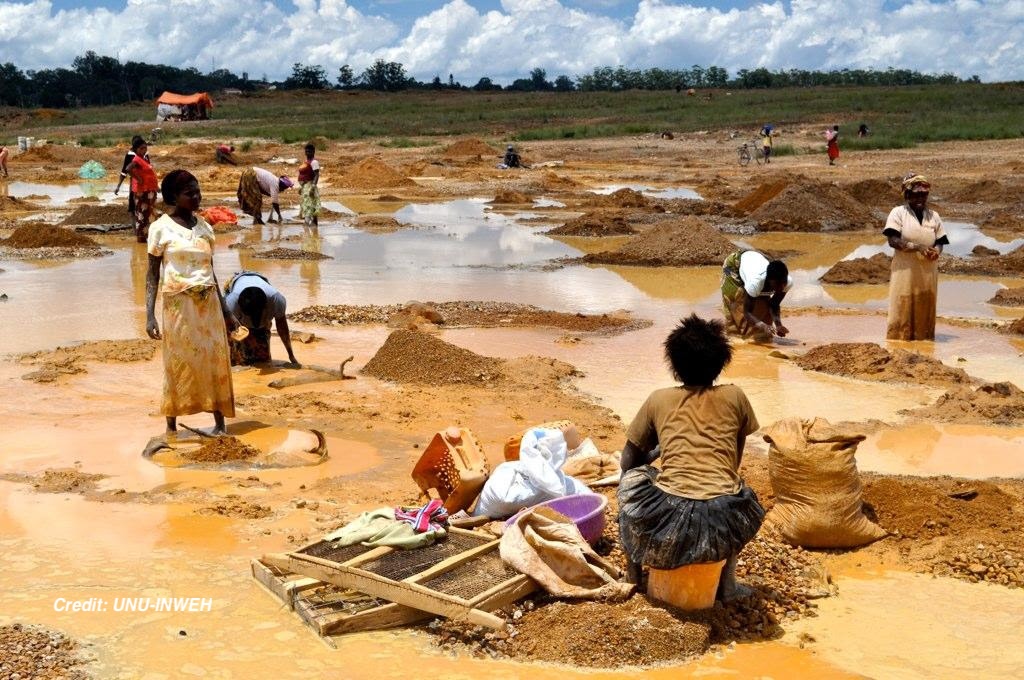
Health burden falls hardest on women and children – Mining-related water contamination is creating serious public health emergencies. In the Democratic Republic of Congo (DRC), for example, a major cobalt producer, 72% of people living near mining sites reported skin diseases, and 56% of women and girls reported gynecological problems.
Birth defect rates in maternal wards near DRC mining areas are markedly elevated compared to those farther away, including neural tube defects (which can lead to serious infant brain and spine defects) at a rate of 10.9 per 10,000 births and lower limb defects at 8.8 per 10,000 births.
The psychosocial toll is also documented. Residents of mining communities in Calama, Chile and Mibanze, DRC describe living in constant fear, anxiety, and a sense of being ‘sacrificed’ so that wealthier regions can advance. Studies link water insecurity and chronic pollution exposure to elevated rates of anxiety, depression, and in extreme cases, suicide.
And approximately 30% of mining sites in the DRC employ children, who typically lack basic health and safety protections.
In the DRC, more than 80% of mineral output is controlled by foreign industrial mines, limiting local economic gains. Despite the country’s vast mineral wealth, over 70% of the DRC’s population lives on less than $2.15 per day.
“The green energy transition is among the most important undertakings of our time. But the evidence we’ve gathered shows that the communities doing the actual digging, breathing the dust, and losing access to clean water are largely excluded from its benefits,” says UNU-INWEH scientist Dr. Abraham Nunbogu, the report’s lead author.
“If we don’t correct the governance failures driving this, we will have built the clean energy economy of the future on the same extractive injustices as the fossil fuel economy of the past.”
Urgent policy action required – The report calls for a fundamental shift in how the global community governs critical mineral supply chains.
Key recommendations include mandatory international due diligence standards to replace voluntary compliance, legally binding mechanisms for ethical sourcing and environmental justice, strict pollution and wastewater controls including zero-discharge systems, and independent monitoring of water use and heavy metal contamination.
The report also calls for investment in circular economy solutions, including advanced recycling of batteries, electronics, and renewable energy components, to reduce pressure on primary extraction.
The report notes that the issues bear directly on progress towards UN Sustainable Development Goals 6 (clean water and sanitation), 3 (good health and well-being), 1 (no poverty), 7 (affordable and clean energy), and 10 (reduced inequalities).
“This rigorous, evidence-based investigation by UNU scientists addresses a problem the world urgently needs to confront,” says Prof. Tshilidzi Marwala, UN Under-Secretary-General and Rector of the United Nations University.
“A transition that deepens poverty, undermines access to clean water, and concentrates health burdens on the world’s most marginalized communities is not a transition toward the UN’s Sustainable Development Goals. It is a step away from them. We cannot give up on the digital transition but we need to do it right.”
Drawing on empirical analyses, scientific studies, and field evidence from the Lithium Triangle, the Democratic Republic of the Congo, and other high-risk extraction regions, the report presents what the authors describe as one of the most overlooked injustices of the global sustainability transition.
Importantly, the report makes clear this is not exclusively a problem of distant or developing regions. The Thacker Pass lithium mine in Nevada, the largest known lithium deposit in the United States, would require up to 3.5 billion litres of water annually, largely by diverting water rights from farming communities in the Quinn River Valley.
In Canada, the 2014 Mount Polley copper/gold mine disaster in British Columbia released roughly 25 million cubic metres of toxic waste into rivers and lakes, contaminating drinking water sources and devastating Indigenous communities. The report calls it one of Canada’s worst mining-related environmental failures.
“Water insecurity is not a side effect of critical mineral mining, it is a systemic outcome of how the global supply chain is currently designed and governed,” says Prof. Madani. “Without binding international standards, mandatory disclosure, and genuine community co-governance, the demand surge projected for the coming decades will make the current situation dramatically worse.”
The report argues that without binding global rules, the current system will continue to externalize environmental and health costs.
Key recommendations include: Mandatory international due diligence standards to replace voluntary compliance, with legally binding mechanisms for ethical sourcing and environmental justice
Strict pollution and wastewater controls, including zero-discharge systems, and independent monitoring of water use and heavy metal contamination
Investment in circular economy solutions — including advanced recycling of batteries, electronics, and renewable energy components — to reduce pressure on primary extraction
Legally mandated benefit-sharing agreements that direct a fair share of mining revenues to affected communities for health, water, and education services
Legal enshrinement of Free, Prior and Informed Consent (FPIC) for Indigenous communities whose lands are affected by extraction
Robust public health systems and mandatory Health Impact Assessments in mining regions, with companies required to contribute financially
Investment in low-water extraction technologies such as direct lithium extraction (DLE) to reduce freshwater consumption
“The data collected for this report makes a stark case, documenting severe health and environmental outcomes in communities that will probably never own an electric vehicle or benefit from the technologies their land is being destroyed to build, in the foreseeable future” says Dr. Nunbogu.
“These hidden costs of the energy transition remain largely invisible to regulators and the public because reliable, publicly accessible data on water usage and pollution at specific mining sites remains scarce. Without open and verifiable data, we cannot hold supply chains accountable, and we cannot ensure that the transition is equitable. That is not a technical failure, it is a governance failure.”
By the numbers – Demand for critical minerals tripled between 2010 and 2023
Lithium demand rose 30% in 2022 alone; cobalt and nickel demand grew 70% and 40% respectively from 2017 to 2022
Total global trade value of critical minerals exceeded USD 320 billion by 2022
Demand projected to more than double by 2030 and quadruple by 2050
Graphite, lithium, and cobalt demand could rise by nearly 500% by 2050 relative to 2020 levels
Meeting Paris Agreement targets would require a ninefold increase in lithium demand and a doubling of cobalt and nickel demand by 2040
Water – 1.9 million litres of water required to produce one tonne of lithium
An average lithium mine producing 11,000 tonnes annually uses roughly 20 billion litres of water — enough to cover the annual domestic water needs of 2.8 million people in sub-Saharan Africa
2024 global lithium output (excluding US): ~240,000 tonnes, requiring an estimated 456 billion litres of water — equivalent to the annual domestic water needs of 62 million people in sub-Saharan Africa
Lithium mining accounts for up to 65% of regional water usage in Chile’s Salar de Atacama
Thacker Pass mine (Nevada, USA) would require up to 3.5 billion litres of water annually
Water table in Atacama brine-well areas dropped by up to 9 metres from 1990 to 2015
16% of critical mineral mining sites are in areas already classified as water-stressed
54% of energy transition mineral projects are on or near indigenous peoples’ lands
Toxic waste – Each tonne of rare earth elements produced generates ~2,000 tonnes of toxic waste overall, plus 1 tonne of radioactive residue and 75 cubic metres of wastewater
2024 global rare earth production generated an estimated 707 million metric tonnes of toxic waste — equivalent to ~59 million loaded garbage trucks, or the annual municipal waste of approximately 1.4 billion people
~70% of that waste (490 million metric tonnes) was generated in China
Concentration of reserves and production – Africa holds 30% of the world’s critical mineral reserves
DRC, Madagascar, and Morocco hold over 50% of global cobalt deposits; DRC’s global cobalt production share has remained above 60% from 2020 to 2024
South Africa holds ~90% of global platinum reserves and accounts for ~70% of global production
The Lithium Triangle (Argentina, Bolivia, Chile) holds over 50% of world lithium reserves
Indonesia holds 42% of global nickel reserves and in 2023 accounted for 51% of global nickel production
Over 80% of DRC mineral output is controlled by foreign industrial mines; Indonesian companies control less than 10% of national nickel production
Health impacts in DRC – 72% of respondents near DRC mining sites reported skin diseases56% of women and girls reported gynecological issues; 14% reported similar issues among teenage girls.
Neural tube defects near DRC mining areas: 10.9 per 10,000 births
Lower limb defects: 8.8 per 10,000 births; cleft lip/palate: 7.2 per 10,000; abdominal wall defects: 6.4 per 10,000
Cobalt concentrations found to be higher in umbilical cord blood than in maternal blood at delivery
~30% of DRC mining sites employ children, often without basic health or safety protections; children as young as seven work without protective equipment
Poverty and inequality – 73.5% of DRC’s population lives on less than $2.15 per day
64% of DRC’s population lacked basic drinking water access in 2024 — despite the country holding more than 50% of Africa’s freshwater reserves
Namibia, Zambia, and DRC hold over 30% of world critical mineral deposits, but most profits flow to multinational corporations and mining companies in the Global North
Indonesia: domestic companies control less than 10% of national nickel production
* * * *
Report Information – Nunbogu, A., Farsi, A., Matin, M., Madani, K. (2026). Critical Minerals, Water Insecurity and Injustice. United Nations University Institute for Water, Environment, and Health (UNU-INWEH), Richmond Hill, Ontario, Canada, doi: 10.53328/INR25ABN002
* * * *
About UNU-INWEH – Marking its 30th anniversary of operation in 2026, the United Nations University Institute for Water, Environment and Health (UNU-INWEH) is one of 13 institutions that comprise the United Nations University (UNU), the academic arm of the UN.
Known as ‘The UN’s Think Tank on Water’, UNU-INWEH addresses critical water, environmental, and health challenges around the world. Through research, training, capacity development, and knowledge dissemination, the institute contributes to solving pressing global sustainability and human security issues of concern to the UN and its Member States. Headquartered in Richmond Hill, Ontario, UNU-INWEH has been hosted and supported by the Government of Canada since 1996. With a global mandate and extensive partnerships across UN entities, international organizations, and governments, UNU-INWEH operates through its UNU Hubs in Calgary, Hamburg, New York, Lund, and Pretoria, and an international network of affiliates.
* * * * *
73.5% of DRC’s population lives on less than $2.15 per day
64% of DRC’s population lacked basic drinking water access in 2024, despite the country holding more than 50% of Africa’s freshwater reserves
Namibia, Zambia, and DRC hold over 30% of world critical mineral deposits, but most profits flow to multinational corporations and mining companies in the Global North
Read the full report: https://bit.ly/4sNLgos
Images / figures used in the report: https://bit.ly/4u4ZT7V
UNU-INWEH Director Kaveh Madani and co-authors are available for interviews
Contacts:
Terry Collins, terrycollins1@gmail.com, +1-416-878-8712erry Collins & Associates | 295 Wright Ave. In the news: https://bit.ly/3WJo8cQ | Toronto, ON M6R1L8 CA
Alexander Tajmur, atajmur@unu.edu, +1 (942) 380 9907
William Smyth, william.smyth@unu.edu, +1-647-919-3318
United Nations correspondent journalists – United Nations correspondent journalists – United Nations journalism articles – United Nations journalism articles – United Nations News – UNCA Awards