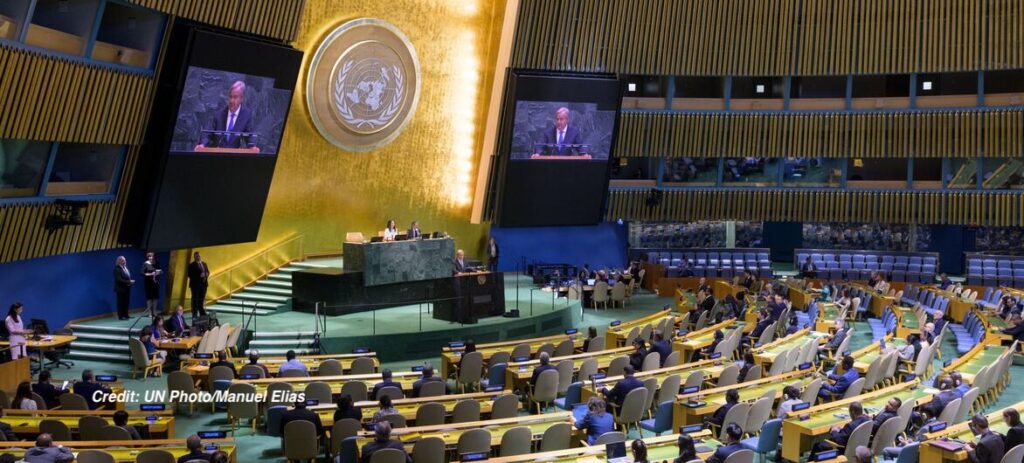
New York, 8 September 2026 – The United Nations has opened its 81st annual session trusting that world leaders who will take part in the discussions will work out solutions for the current geo-political divisions, on-going conflicts in the Middle East and Ukraine, climate disasters and starvation in many parts of the world.
The high-level political session to be held in the UN General Assembly will last a whole week starting from 22 September with the presence of more than 80 heads of state and dozens of prime ministers and ministers representing the 193 UN member states.
The session was launched under the theme of “Restoring trust, managing transformation: A United Nations that delivers for all.” Ambassador Khalilur Rahman of Bangladesh is the new president of the assembly for the next 12 months, taking over from Annalena Baerbock, a former foreign minister of Germany.
“We must make the United Nations fit for the future,” Rahman said in first address to the assembly. “We have a situation where trust is in deficit. This is not 1945. This is the 81st session. The world has moved on. The Organization must move on, and I’ll help that process.”
Political debate 22-28 September – On the first day of the political debate, a total of 32 presidents have registered to deliver speeches, including presidents of Brazil, the United States, Jordan, Turkeye, Peru, Egypt, France, South Korea, Mongolia and Japan. Scores of other heads of state and high-ranking ministers will also speak.
UN Secretary-General Antonion Guterres urged UN member states to rebuild trust in the multilateral system.
“The institutions of the multilateral system, from the UN Security Council to the international financial architecture, are straining to meet the moment,” he said. “International law and human rights — the core of our organization — are too often flouted with impunity. And geopolitical mistrust and suspicion continue to block the effective solutions we need — and erode people’s faith in the possibilities of global cooperation.”
“But as I join you in this opening of a General Assembly session for the last time as Secretary-General, I have enormous hope thanks to the work that happens here.”
In her final address as president of the UN General Assembly, Annalena Baerbock said she was moved by the determination of many inspiring colleagues who are convinced more than ever of the importance and necessity of the United Nations.
“And to those out there who argue that the UN is irrelevant or failing – especially in these new geopolitical realities, I would simply say consider, for just one minute, the alternative – a world without the UN: Consider the millions of children who would not be in school without UNICEF. Consider the women who only dare to walk out of their homes without fear of being raped because UN peacekeepers are deployed. Consider the thousands of families around the world receiving humanitarian assistance, including right now in Nepal and China.”
UN Secretary general selection – Member states are called to make a difficult decision during the session, which is to select a new UN Secretary General to replace the current leader Antonio Guterres of Portugal who is completing his two five-year terms by the end of 2026. Some UN member states and organizations have demanded that the next UN secretary general should be a woman after only men have been leading the UN since it was established in 1945.
So far candidates included: Michelle Bachelet (from Chile); María Fernanda Espinosa (Ecuador); Rafael Grossi (Argentina); Rebeca Grynspan (Costa Rica); Olara Otunnu (Uganda); Carolyn Rodrigues Birkett (Guyana); Macky Sall (Senegal); Virginia Gambia (Argentina) and Ivonne A-Baki (Ecuador).
While world leaders are addressing the UN General Assembly session, the UN also holds discussions on various important topics. They include:
23 September – Climate Action and the Just Transition. The UN said climate summit, convened by UN Secretary-General António Guterres, will bring together leaders from major economies, developed and developing countries, vulnerable nations, and major energy producers and consumers to strengthen cooperation at a pivotal moment. Ten years after the Paris Agreement, the climate crisis has entered a new phase in which overshoot is now inevitable, while the energy transition accelerates.
24 September – High-level Plenary Meeting to Address the Existential Threats Posed by Sea Level Rise. This meeting will focus on building common understanding, mobilizing political leadership, and promoting multisectoral and multi-stakeholder collaboration and international cooperation towards the objective of “addressing the threats posed by sea-level rise”. Participants will work towards developing comprehensive solutions and actionable commitments to combat sea level rise, ensuring a resilient and sustainable future including for small island developing states and low-lying coastal areas.
25 September – High-level Meeting on Pandemic Prevention, Preparedness and Response. The meeting aimsat mobilizing political will at the national, regional and international levels for pandemic prevention, preparedness and response. Guided by the theme, “Fostering a multilateral and intergenerational approach to prevent, prepare for and respond to pandemics and public health emergencies, through the principles of equity and solidarity,” the meeting will culminate in the approval of a concise, action-oriented political declaration agreed upon by consensus through intergovernmental negotiations.
29 September – High-level Plenary Meeting to Commemorate and Promote the International Day for the Total Elimination of Nuclear Weapons. Achieving global nuclear disarmament is the highest disarmament priority of the United Nations. This annual high-level plenary meeting commemorates and promotes the International Day for the Total Elimination of Nuclear Weapons.
(By J.Tuyet Nguyen)
United Nations correspondent journalists – United Nations correspondent journalists – United Nations journalism articles – United Nations journalism articles – United Nations News – UNCA Awards