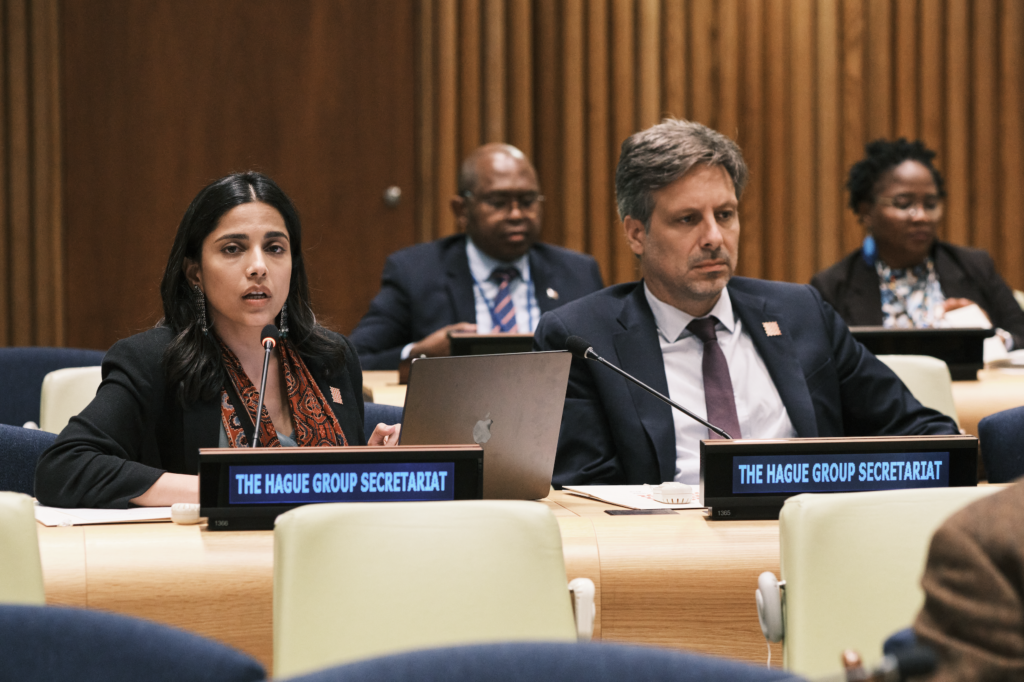
New York, 25 September 2026 – At a time of profound strain on the international legal order, the Republic of South Africa and Malaysia convened the High-Level Meeting in Defence of International Law at United Nations Headquarters.
The meeting brought together 40 States of The Hague Group, represented by Ministers of Foreign Affairs, Ministers of Justice and senior diplomats, alongside representatives of intergovernmental organisations and international legal experts, to consider a fundamental question: how can States act collectively to ensure that international law is not merely proclaimed, but enforced, and that the institutions entrusted with upholding it are protected from efforts to undermine their independence and effective functioning?
Concrete proposals – Participants advanced a series of concrete proposals to strengthen the implementation and enforcement of international law. These included consideration of a new United Nations mechanism, drawing upon the experience of the Special Committee against Apartheid, to monitor implementation, report on compliance and facilitate coordinated action among States; continued efforts towards a United Nations Security Council arms embargo on Israel; and coordinated measures to protect the International Criminal Court, its judges and officials from threats, sanctions and intimidation.

The Charter of the United Nations established an international order founded upon the sovereign equality of States, the peaceful settlement of disputes, respect for international law, and the equal rights of nations large and small. Eighty-one years later, these principles face profound challenges. Grave violations of international law continue in multiple contexts, while the institutions and individuals entrusted with upholding it face growing political, financial and coercive pressure.
Participants reaffirmed that the defence of international law cannot depend upon where violations occur, who commits them, or the political power of the States involved. The consistent application of international law is essential to the legitimacy and integrity of the multilateral system.
State representatives highlighted that the situation in the Occupied Palestinian Territory, including East Jerusalem, remains an urgent test of that system. International judicial bodies have made their determinations, including in the Advisory Opinion of the International Court of Justice of 19 July 2024. The General Assembly acted upon those determinations through resolution A/RES/ES-10/24. Yet grave violations continue, accountability remains elusive, and structures of illegality and impunity persist. The challenge before the international community is therefore not simply one of establishing legal norms. It is one of giving those norms practical effect.
Discussions at the High-Level Meeting focused on three interconnected priorities.
Towards a new multilateralism
Participants reaffirmed the sovereign equality of States and the need for a multilateral system capable of protecting the equal rights of nations large and small. Discussions emphasised the importance of strengthening cooperation among States in defence of the Charter and considered proposals for renewed multilateral mechanisms capable of responding to persistent and systematic violations of international law, including consideration of a United Nations mechanism drawing upon the experience of the 1962 Special Committee against Apartheid.
From complicity to compliance
Participants discussed the responsibility of States to give practical effect to their existing obligations under international law, including third-State obligations arising in situations of serious violations. Proposals included strengthening coordination across national and international mechanisms; sharing experiences concerning measures already adopted by States; and continuing efforts towards a United Nations Security Council arms embargo in relation to Israel.
Participants emphasised that legal obligations must be reflected in the practical decisions States take across their national systems and that greater coordination can strengthen the effectiveness of measures undertaken by individual States.
From impunity to accountability
Participants expressed concern regarding efforts to weaken or obstruct the institutions entrusted with upholding international law. They noted attempts to intimidate, sanction or otherwise undermine international courts, their judges and officials, United Nations mandate holders, human rights organisations and other actors carrying out mandates connected to the defence of international law.
Particular concern was expressed regarding intimidation, threats and sanctions directed at the International Criminal Court, its judges and officials. Participants considered measures through which States can collectively protect the independence and effective functioning of the Court and other international legal institutions, oppose retaliation against those carrying out their mandates, and support the implementation and enforcement of their decisions.
The meeting underscored that international institutions cannot defend the international legal order alone. Their decisions depend upon States for implementation, and their independence requires States to defend their ability to discharge their mandates without intimidation or retaliation.
Participants further emphasised the importance of greater coordination among States. Collective action can strengthen implementation, increase the effectiveness of measures taken at the national level, reduce fragmentation and support States facing threats or pressure for acting consistently with their international legal obligations.
We, the Meeting’s co-sponsors, welcome the perspectives and proposals advanced during today’s meeting and will continue consultations with participating States on avenues for practical cooperation emerging from these discussions.
We reaffirm our conviction that the authority of international law derives not merely from its proclamation, but from its enforcement.
We reaffirm the Charter of the United Nations and its promise of the equal rights and self-determination of peoples and of the equal rights of nations large and small.
We affirm that international law must apply equally and consistently; that international institutions must be able to fulfil their mandates independently and without intimidation or retaliation; that grave violations must carry consequences; and that States must cooperate to give practical effect to their international obligations. The alternative is an international order in which power determines which laws are respected, which judgments are implemented and whose rights are protected. That is not the international order promised by the Charter.
The defence of international law is therefore not the responsibility of any one State, region or institution. It is a common responsibility.
| H.E. Ronald Lamola Minister of International Relations and Cooperation of the Republic of South Africa H.E. Mohamad Hasan Minister of Foreign Affairs of Malaysia |
| Read the statement online at thehaguegroup.org. |
| Media contact Varsha Gandikota, Executive Secretary of The Hague Group, is available for interviews and media appearances. To arrange, contact: Andrew Bard Epstein, Press Director andrew@thehaguegroup.org | +1 914 316-4728 thehaguegroup.org |
United Nations correspondent journalists – United Nations correspondent journalists – United Nations journalism articles – United Nations journalism articles – United Nations News – UNCA Awards