
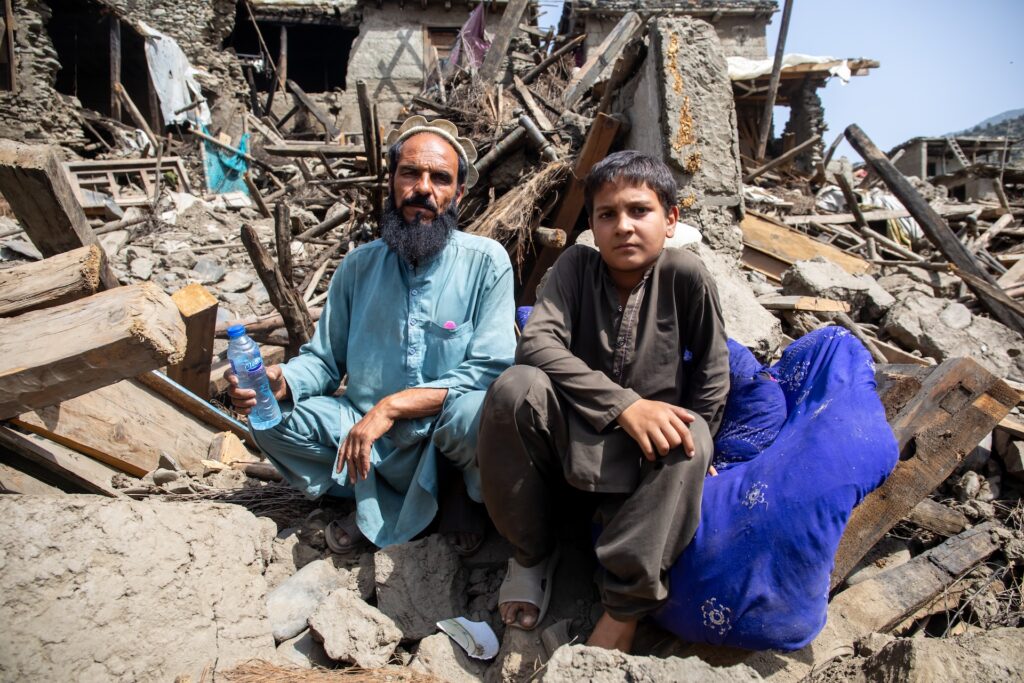
Note: This weekend marks six month since the devastating earthquake in eastern Afghanistan. The below press release from the Norwegian Refugee Council (NRC) warns that the sharp decline in funding risks the closure of services for affected families and puts them in danger of being displaced again.
Oslo, 26 February 2026 – Six months on from the 6.0-magnitude earthquake which hit Kunar province, eastern Afghanistan, on 31st August 2025, funding for humanitarian support to affected families has sharply declined, risking the closure of many services. Without urgent support families are in danger of being displaced again, warns the Norwegian Refugee Council (NRC).
- The 6.0-magnitude earthquake that hit Kunar province killed over 2,150 people. An estimated 499,000 people were affected, including 221,000 in acute need of urgent assistance. 186,000 people were assessed as needing shelter and non-food items (NFI) assistance (OCHA). 8,000 homes were destroyed (OCHA).
- US$ 111.5 million are required for the earthquake response (OCHA).
“Thousands of families who lost their homes in August’s devastating earthquake are still in limbo. Many have been living in tents or makeshift shelters since the disaster. They have had to endure six months of harsh weather and a biting winter with little more than canvas over their heads,” said Jacopo Caridi, NRC’s country director for Afghanistan. “Now many humanitarian organisations including NRC are running out of funding and will be forced to end their work in the area. This will mean the closure of key services and little chance of proper shelters for families who lost everything.”
“We fear that the scale-back of support means people will have no choice but to seek services and a future elsewhere in the country, adding more displacement and distress. International donors must step up to support the long-term future of Afghans, just as they stepped up to support them when the earthquake struck. Families must be helped to rebuild their lives where they are.”
In August, 8,000 families lost their homes in the earthquake, with a total of 186,000 people requiring emergency shelter support and basic household items. NRC and other humanitarian organisations provided families with emergency tents alongside other key services such as clean water, food, and healthcare. Local authorities also provided shelters for the most vulnerable families, however their funding is also limited making international support vital.
Emergency tents are life-saving in a crisis, but are designed to be stop-gap in the first weeks and months of displacement. They are not adequate as long-term housing.
“We are still living in tents, and our partially repaired house is not safe enough for my family,” said 27-year-old Gul Bacha, who lives in Kunar province. “The emergency assistance helped us survive the first months, but since then, support has stopped. With food distributions ending, we are worried about how we will manage in the coming months. Without continued assistance, families like mine remain at serious risk.”
A lack of aid funding for Afghanistan is leaving significant gaps in the humanitarian response. In 2025, just over 41 per cent of required funding was delivered. This does not take into account the widespread cuts to humanitarian aid from US and many European countries, which will only become evident this year.
Emergency shelter and non-food items were the most underfunded sector across the country with little over 16 per cent of required funds delivered last year. In 2026, the level of required funding so far delivered currently stands at under 1 per cent.The gaps in aid funding means longer-term interventions, after the acute phase of an emergency has passed, are often missing. This includes more substantial shelters, water and sanitation infrastructure, and livelihood support so people can rebuild their lives. This means Afghans are trapped in a cycle of emergencies, unable to plan for their futures or provide for their families.
“As the contraction of global aid funding forces donors to make difficult choices about which crisis to support, families are having their choices taken from them. Afghanistan requires aid today to help the 21.9 million people in need across the country, including the millions who have recently returned with almost nothing from Pakistan and Iran,” said Caridi.
Notes to editors:
- Photos from Kunar are available for free use here and b-roll is available here.
- A 6.0-magnitude earthquake hit Kunar province on 31st August 2025 killed over 2,150 people. An estimated 499,000 people were affected, including 221,000 in acute need of urgent assistance. 186,000 people were assessed as needing shelter and non-food items (NFI) assistance (OCHA). 8,000 homes were destroyed (OCHA).
- US$ 111.5 million are required for the earthquake response (OCHA).
- In 2026, 21.9 million people across Afghanistan require humanitarian assistance (OCHA). A total of 1.71 billion US dollars is required to meet the needs of 17.5 million people targeted for assistance. As of mid-February, just 156.6 million, or 9.1 per cent, has been delivered (OCHA).
- In 2025, 2.42 billion US dollars was required for the humanitarian response in Afghanistan. By the end of the year just 996 million, or 41.2 per cent, was delivered (OCHA).
- Emergency shelter and NFI requires 160.3 million US dollars in 2026. Just 1.5 million US dollars, or 0.9 per cent, has been delivered to date (OCHA). In 2025, 179.1 million US dollars was required and 29.4 million (16.4 per cent) was delivered (OCHA). This makes emergency shelter and NFI the lowest of all sectors in 2025 and 2026.
- In 2026, the Shelter Cluster in Afghanistan reduced its targets for emergency shelter by 14 per cent, NFI assistance and seasonal winter support by 30 per cent in comparison to 2025 targets. This adjustment is due to increased prioritisation to realistically reflect the shrinking funding environment impacting humanitarian operations and programmes (OCHA).
- NRC has supported families impacted by the earthquake in the hardest-hit areas of Kunar, Nangarhar, and Laghman provinces. NRC has reached more than 60,000 people with assistance tailored to urgent needs, including the construction and rehabilitation of water systems and latrines, distribution of emergency food, multipurpose cash and winterisation support, hygiene and shelter repair kits, as well as protection counselling services. Six months on, needs remain severe. However, due to funding constraints, NRC is forced to phase out its operations in the area, while continuing to support displaced communities across the country through its water and sanitation, shelter, protection, education, and information and legal advice.
For more information or to arrange an interview, please contact: NRC global media hotline: media@nrc.no, +47 905 62 329 – Maisam Shafiey, advocacy and communication manager, Kabul, Afghanistan: Maisam.Shafiey@nrc.no, +93706453029
United Nations journalists – United Nations journalists – United Nations journalists
United Nations News – United Nations News – UN Correspondents Association – UNCA Awards