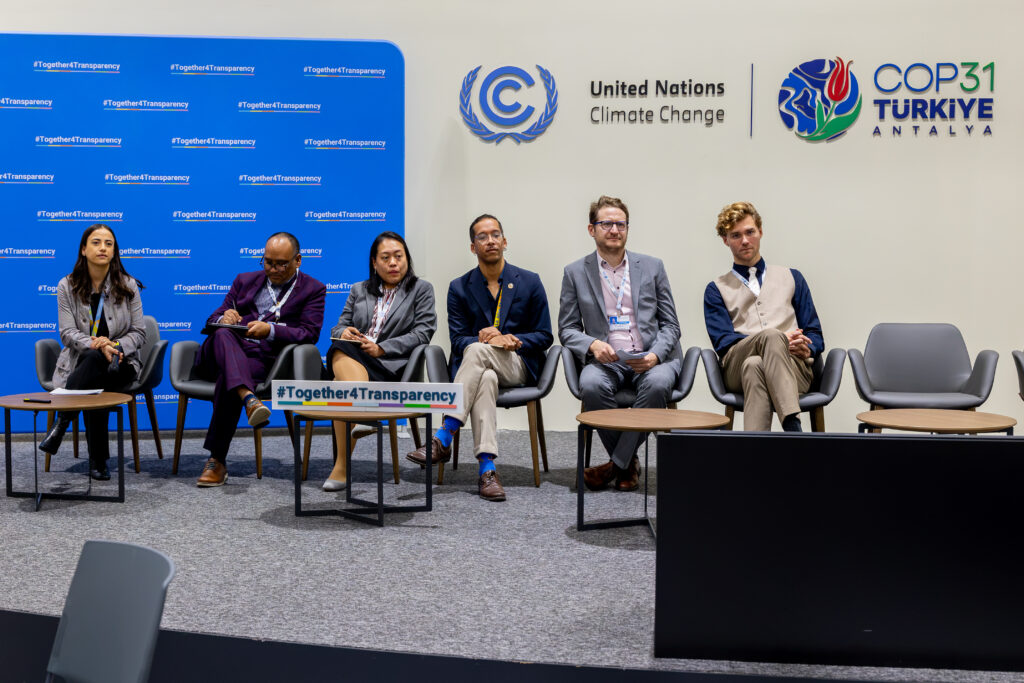
As global leaders gather in Antalya, Türkiye for the 31st Conference of the Parties to the UNFCC (COP31), Rights and Resources Initiative (RRI) is calling for community rights-based approaches to end deforestation and drive the energy transition.
Washington, D.C., November 18, 2026 – With COP31 underway in Antalya, protection of communities’ collective rights and livelihoods in global climate action must be at the center of negations, says Rights and Resources Initiative (RRI), the world’s largest coalition to promote the rights and leadership of Indigenous Peoples, Afro-descendant Peoples, and local communities.
RRI has brought a delegation of 26 Indigenous, local community, and Afro-descendant leaders to Antalya, a majority of them women and youth, to call for greater recognition and protection of these groups’ rights and leadership in discussions on climate finance, deforestation, energy transition, and human rights. These leaders represent communities in Asia, Africa, and Latin America, spanning a majority of the world’s critical ecosystems.
The summit comes at a critical moment. As governments begin to implement their commitments and voluntary roadmaps to halt deforestation, mobilize $1.3 trillion annually in climate finance by 2035, and transition away from fossil fuels, RRI is urging them to ensure that communities have the legal rights, authority, resources, and meaningful participation needed to safeguard their territories.
Under the banner #RightsAreTheRoadmap, RRI is advancing five interconnected priorities at COP31. These include recognizing secure community tenure as an essential foundation of climate action; integrating community rights into climate commitments and implementation, strengthening recognition and participation of all rightsholders, particularly women and youth; expanding direct climate financing to locally-led projects; and ensuring that Afro-descendant Peoples, local communities, and Peoples in Isolation and Initial Contact (PIACI), are explicitly recognized in the Convention’s final text, climate policies and agreements.
Alain Frechette, RRI’s Director for Climate and Conservation, said, “Where community rights are insecure, a roadmap is just a promise on paper. COP31 is the moment to move from symbolic pledges to rights-based implementation and to prevent an energy transition that repeats the extraction and dispossession of the past. As countries pursue their deforestation targets, expand clean energy infrastructure, and increase investment in critical minerals, they must first ensure that communities’ tenure rights, collective livelihoods, and self-determined governance institutions are fully recognized, respected and protected.”
Another key priority is ensuring community rights are reflected in the just transition roadmap under negotiation at the COP. In a policy brief on territorial rights and the energy transition in Brazil, Bolivia, and Colombia, RRI partners in Latin America urged the Parties to adopt stronger community safeguards and ensure that the transition to clean energy does not repeat past patterns of land dispossession and exclusion.
Carla Cardenas, Director of the Latin America Program at RRI, said: “The energy transition must not come at the expense of Indigenous Peoples’ lands, territories, and rights. Critical minerals must not become the next frontier of dispossession. Protecting territories before granting mining concessions, ensuring FPIC, and holding investors accountable must be at the heart of a just energy transition. We must also recognize that communities have their own visions and pathways for the energy transition. It cannot be driven solely by large-scale projects imposed from outside.”
In a new study to be released at the Global Landscapes Forum on November 18, RRI and researchers at University of Notre Dame are launching an initial assessment of the policies, institutions, and public services needed to advance community livelihoods in nearly half of the world’s remaining tropical forests. The study has key implications for the official Roadmap to Halt and Reverse Deforestation by 2030 unveiled on the opening day of COP31 in Antalya. Given the role of agriculture and land-use changes in driving global forest loss, the roadmap centers local economies and livelihoods as vital to long-term success.
“Securing collective tenure rights is fundamental, but recognition alone doesn’t ensure that communities can exercise those rights or realize their livelihood aspirations,” said Bryson Ogden, RRI’s Director of Rights and Livelihoods. “Our research shows why governments and development partners need to look beyond legal recognition and address the wider conditions that shape community livelihoods—from access to infrastructure, finance, and technical support to accountable institutions and meaningful participation in decision-making. Supporting communities to pursue their own economic and development priorities is essential to sustaining both their livelihoods and the forests and ecosystems they steward.” As governments negotiate the next steps toward implementation of climate commitments and roadmaps, RRI is urging them to translate promises into meaningful progress for the communities whose lands and resources are central to achieving climate goals.
Learn about RRI’s side-events and priorities at COP31.
About Rights and Resources Initiative (RRI) – RRI is a global coalition of over 200 members working to advance the land, forest, and resource rights of Indigenous Peoples, Afro-descendant Peoples, local communities, and the women and youth within these communities. RRI supports data, analysis, and advocacy to promote rights-based approaches to climate, conservation, and sustainable development.
Learn more: www.rightsandresources.org.
Media Contact: Leah Williams, Account Coordinator, Top of Mind PR
United Nations correspondent journalists – United Nations correspondent journalists – United Nations journalism articles – United Nations journalism articles – United Nations News – UNCA Awards