
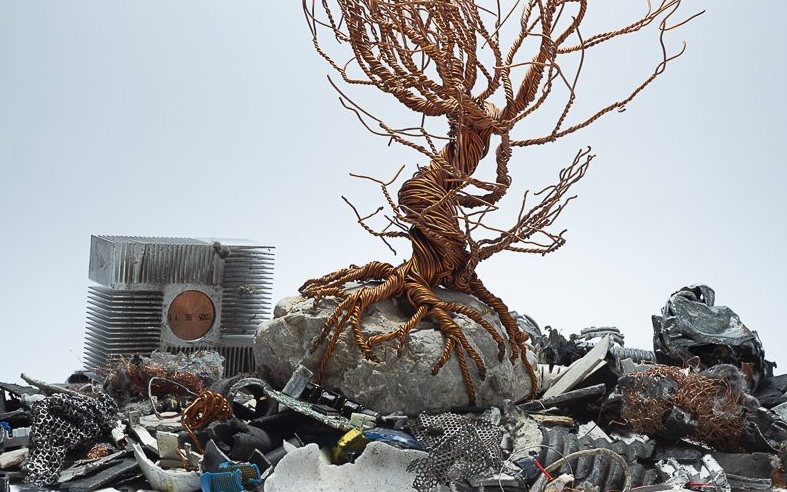
Global E-waste Surging: Up 21% in 5 Years
A record 53.6 million tonnes (Mt) of e-waste was produced globally in 2019,
the weight of 350 cruise ships the size of the Queen Mary 2;
$57 billion in gold and other components discarded – mostly dumped or burned
(Released from Bonn, Geneva, Vienna, London and Toronto
July 2, 2020
The report in full, including regional e-waste breakdowns, is available for media preview at https://bit.ly/3dFDZQQ
Post-embargo at: www.globalewaste.org
Video, photos, graphics, backgrounders: https://bit.ly/2AapxCI
Lead contact: Terry Collins, +1-416-878-8712, tc@tca.tc )
A record 53.6 million metric tonnes (Mt) of electronic waste was generated worldwide in 2019, up 21 per cent in just five years, according to the UN’s Global E-waste Monitor 2020.
The new report also predicts global e-waste — discarded products with a battery or plug — will reach 74 Mt by 2030, almost a doubling of e-waste in just 16 years. This makes e-waste the world’s fastest-growing domestic waste stream, fueled mainly by higher consumption rates of electric and electronic equipment, short life cycles, and few options for repair.
Only 17.4 per cent of 2019’s e-waste was collected and recycled. This means that gold, silver, copper, platinum and other high-value, recoverable materials conservatively valued at US $57 billion — a sum greater than the Gross Domestic Product of most countries – were mostly dumped or burned rather than being collected for treatment and reuse.
According to the report, Asia generated the greatest volume of e-waste in 2019, some 24.9 Mt, followed by the Americas (13.1 Mt) and Europe (12 Mt), while Africa and Oceania generated 2.9 Mt and 0.7 Mt respectively.
For perspective, last year’s e-waste weighed substantially more than all the adults in Europe, or as much as 350 cruise ships the size of the Queen Mary 2, enough to form a line 125 km long.
E-waste is a health and environmental hazard, containing toxic additives or hazardous substances such as mercury, which damages the human brain and / or coordination system.
Other key findings from the Global E-waste Monitor 2020:
• Proper e-waste management can help mitigate global warming. In 2019, an estimated 98 Mt of CO2-equivalents were released into the atmosphere from discarded fridges and air-conditioners, contributing roughly 0.3 per cent of global greenhouse gas emissions
• In per capita terms, last year’s discarded e-waste averaged 7.3 kg for every man, woman and child on Earth
• Europe ranked first worldwide in terms of e-waste generation per capita with 16.2 kg per capita. Oceania came second (16.1 kg) followed by the Americas (13.3 kg). Asia and Africa were much lower: 5.6 and 2.5 kg respectively
• E-waste is a health and environmental hazard, containing toxic additives or hazardous substances such as mercury, which damages the human brain and / or coordination system. An estimated 50 tonnes of mercury – used in monitors, PCBs and fluorescent and energy-saving light sources – are contained in undocumented flows of e-waste annually
• E-waste in 2019 was mainly comprised of small equipment (17.4 Mt), large equipment (13.1 Mt), and temperature exchange equipment (10.8 Mt). Screens and monitors, lamps, small IT, and telecommunication equipment represented 6.7 Mt, 4.7 Mt, and 0.9 Mt respectively
• Since 2014 the e-waste categories increasing fastest in total weight terms: temperature exchange equipment (+7 per cent), large equipment (+5 per cent), lamps and small equipment (+4 per cent). According to the report, this trend is driven by the growing consumption of those products in lower income countries, where those products improve the living standards. Small IT and telecommunication equipment have been growing more slowly, and screens and monitors have shown a slight decrease (-1 per cent), explained largely by lighter flat panel displays replacing heavy CRT monitors and screens
• Since 2014, the number of countries that have adopted a national e-waste policy, legislation or regulation in place has increased from 61 to 78. While a positive trend, this is far from the target set by the International Telecommunication Union which is to raise the percentage of countries with an e-waste legislation to 50 per cent
The Global E-waste Monitor 2020 (www.globalewaste.org) is a collaborative product of the Global E-waste Statistics Partnership (GESP), formed by UN University (UNU), the International Telecommunication Union (ITU), and the International Solid Waste Association (ISWA), in close collaboration with the UN Environment Programme (UNEP). The World Health Organization (WHO) and the German Ministry of Economic Cooperation and Development (BMZ) also substantially contributed to this year’s Global E-waste Monitor 2020.
Comments
“The findings of this year’s UNU-affiliated Global E-waste Monitor suggest that humanity is not sufficiently implementing the SDGs. Substantially greater efforts are urgently required to ensure smarter and more sustainable global production, consumption, and disposal of electrical and electronic equipment. This report contributes mightily to the sense of urgency in turning around this dangerous global pattern.”
- David M. Malone, Rector United Nations University (UNU) & UN Under Secretary General
“Far more electronic waste is generated than is being safely recycled in most parts of the world. More cooperative efforts are required to make aware of this increasing issue and take appropriate countermeasures supplement by appropriate research and training. I am pleased that UNITAR now joins this important Global E-waste Statistics Partnership of UNU, ITU and ISWA, illustrating how valuable these activities are.”
- Nikhil Seth, Executive Director, United Nations Institute for Training and Research (UNITAR) & UN Assistant Secretary-General
”The Global E-waste Monitor highlights the pressing issue of e-waste management in today’s digitally connected world in that the way we produce, consume, and dispose of electronic devices has become unsustainable. Monitoring e-waste streams will contribute to the achievement of the Sustainable Development Goals and tracking the implementation of the ITU Connect 2030 Agenda. The Monitor serves as a valuable resource for governments to improve their global e-waste recycling rate by developing the necessary/needed/required e-waste policies and legislation. ITU will continue to support the efforts made in this report towards the global response required in identifying solutions for e-waste.”
- Doreen Bogdan-Martin, Director, Telecommunication Development Bureau, International Telecommunication Union (ITU)
“E-waste quantities are rising 3 times faster than the world’s population and 13 per cent faster than the world’s GDP during the last five years. This sharp rise creates substantial environmental and health pressures and demonstrates the urgency to combine the fourth industrial revolution with circular economy. The fourth industrial revolution either will advance a new circular economy approach for our economies or it will stimulate further resource depletion and new pollution waves. The progress achieved in e-waste monitoring by the Global E-waste Statistics Partnership is a sign of hope that the world can manage not only to monitor closely the e-waste rise but also to control their impacts and set up proper management schemes”
- Antonis Mavropoulos, President, International Solid Waste Association (ISWA)
“Informal and improper e-waste recycling is a major emerging hazard silently affecting our health and that of future generations. One in four children are dying from avoidable environmental exposures. One in four children could be saved, if we take action to protect their health and ensure a safe environment. WHO is pleased to join forces in this new Global E-waste Monitor to allow evidence, information about health impacts and joint solutions and policies to be made available to protect our future generations’ health.”
- Maria Neira, Director, Environment, Climate Change and Health Department, World Health Organization (WHO)
Join the conversation on social media using hashtag #eWaste
Media contacts:
• Terry Collins, +1 416 878 8712; tc@tca.tc
• Ruediger Kuehr, Director UNU-ViE SCYCLE, +49 228 815 0213/4, kuehr@vie.unu.edu
• Monika Gehner, Head Strategic Communication Division, International Telecommunication Union (ITU), Phone: +41 22 730 5459, Press line: +41 22 730 6039, E-mail: pressinfo@itu.int
• Georgiana Olivier, Communications Manager, International Solid Waste Association (ISWA), +31 636 06 41 83, golivier@iswa.org
About the Global E-waste Statistics Partnership (GESP)
The GESP helps countries compile useful national policy-making statistics using an internationally-recognized harmonized measurement framework. The GESP convenes policy makers, statisticians, and industry representatives to enhance the quality, and their understanding and interpretation of e-waste data. At the global level, the GESP contributes to the monitoring of relevant waste streams, measuring progress towards the Sustainable Development Goals 11.6, 12.4 and 12.5. The GESP allows international organizations, such as the ITU, to measure progress towards their goals. In 2018, the ITU established a target to increase the global e-waste recycling rate to 30 per cent by 2023 – a 12.6 per cent increase from today’s global average.
About the United Nations University (UNU)
UNU is an autonomous organ of the UN General Assembly dedicated to generating and transferring knowledge and strengthening capacities relevant to global issues of human security, development, and welfare. The University operates through a worldwide network of research and training centres and programmes, coordinated by UNU Centre in Tokyo.
The Bonn, Germany-based Sustainable Cycles (SCYCLE) Programme, co-hosted by UNU’s Vice Rectorate in Europe and the United Nations Institute for Training and Research (UNITAR), provides world-class research and action on e-waste. SCYCLE aims to enable societies to reduce the environmental burden caused by the production, consumption and disposal of ubiquitous goods.
About the International Telecommunication Union (ITU)
The International Telecommunication Union (ITU) is the specialized United Nations agency for information and communication technologies (ICTs), driving innovation in ICTs together with 193 Member States and a membership of over 900 companies, universities, and international and regional organizations. Established over 150 years ago in 1865, ITU is the intergovernmental body responsible for coordinating the shared global use of the radio spectrum, promoting international cooperation in assigning satellite orbits, improving communication infrastructure in the developing world, and establishing the worldwide standards that foster seamless interconnection of a vast range of communications systems. From broadband networks to cutting-edge wireless technologies, aeronautical and maritime navigation, radio astronomy, oceanographic and satellite-based earth monitoring as well as converging fixed-mobile phone, Internet and broadcasting technologies, ITU is committed to connecting the world. For more information, visit: www.itu.int.
About the United Nations Institute for Training and Research (UNITAR)
As a dedicated training arm of the United Nations System, the United Nations Institute for Training and Research (UNITAR) provides innovative learning solutions to individuals, organizations and institutions to enhance global decision-making and support country-level action for shaping a better future. UNITAR was created in 1963 to train and equip young diplomats from newly-independent UN Member States with the knowledge and skills needed to navigate through the diplomatic environment. Over the years, UNITAR has acquired unique expertise and experience in designing and delivering a variety of training activities. We have become a leading institute in the provision of customized and creative learning solutions to institutions and individuals from both public and private sectors. With a strategy fully focused on achieving the Sustainable Development Goals (SDGs), UNITAR supports Governments to implement the 2030 Agenda.
About the International Solid Waste Association (ISWA)
The International Solid Waste Association (ISWA) is a global, independent and non-profit making association, working in the public interest promoting sustainable, comprehensive and professional waste management and the transition to a circular economy. ISWA is open to individuals and organisations from the scientific community, public institutions as well as and public and private companies from all over the world working in the field of or interested in waste management. ISWA is the only worldwide waste association that enables its members to network with professionals, companies and institutional representatives.
Copyright © 2015. All Rights Reserved.
Terry Collins & Assoc., Twitter: @TerryCollinsTC, www.tca.tc, 295 Wright Ave., Toronto, Ontario M6R1L8 Canada
SafeUnsubscribe™ natuyet@gmail.com
Forward this email | Update Profile | About our service provider
Sent by tc@tca.tc in collaboration with