
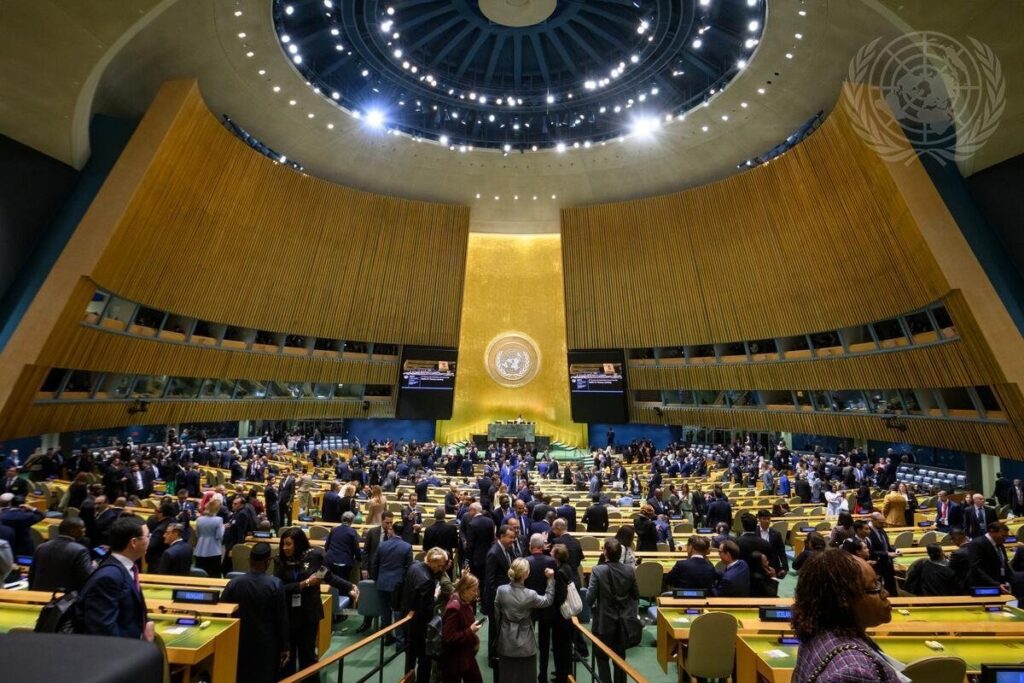
New York, 22 September 2026 – Government leaders attending the 81st annual United Nations General Assembly session at the UN Headquarters used the unique opportunity to demand solutions for some of the biggest challenges facing the world, from reforming the powerful UN Security Council and preventing climate disasters to an AI technology with accountability.
Opening the session attended by representatives of the 193 UN member states, including more than 80 heads of states, UN Secretary General Antonio Guterres pointed out the absence of permanent members from Africa in the powerful UN Security Council, which has 15 countries, five of which are permanent members: the US, Russia, United Kingdom, China and France. Those members can veto decisions by other council members.
“We must also reform the Security Council so that it reflects today’s world with the legitimacy and effectiveness that today’s challenges demand,” Guterres said. “The Security Council was designed in the aftermath of World War II. But the world has fundamentally changed since then. When the UN was founded, most of Africa was still under colonial rule. Today, Africa still has no permanent seat on the Council.
A 21st century Security Council without permanent African representation is unjust and indefensible.”
Guterres pointed out two challenges, saying that climate change is the “most profound intergenerational power imbalance,” warning of a near-certain breach of the 1.5°C threshold. He said polluters have to “pay” and for developed nations to triple adaptation funding. Turning to AI, Guterres warned that power is increasingly concentrated in data, computing capacity and algorithms, advancing faster than humanity’s capacity to govern it.
“The danger is not technology,” he said. “The danger is technology without accountability.”
“Life-and-death decisions must never be surrendered to machines. Killer robots must have no place in our future,” he said, adding that a multilateral AI risk management framework with independent oversight, stating firmly that children must never become test subjects for unregulated systems and that life-and-death decisions must never be surrendered to machines.
Luiz Inácio Lula da Silva, President of Brazil, told the high-level meeting that the UN has failed to rid humanity of the scourge of war and its credibility has never been lower.
“We are all held hostage by the inaction of the Security Council failing to fulfil its role,” he said, citing the high numbers of conflicts since the end of World War II and massive expenses for weapons.
US President Donald Trump said his administration has worked with many countries to implement “the most sweeping reform in UN history.” Trump said the UN budget was cut by 15 per cent in 2026 and over 4,000 positions were eliminated from its bureaucracy and added that while the world organization has “great potential”, it must “stop imposing the far-left agenda of globalist bureaucrats who nobody ever elected.”
“There is no global government, and while I am president, there will be no global taxes,” he said. He also called on all States Parties to the International Criminal Court to formally withdraw from this “rogue institution.”
Recep Tayyip Erdoğan, President of Türkiye, said trust must be restored in the international organization and he welcomed the UN80 Initiative, which offers reform of the organization. He called for Security Council reform, noting that “the world is bigger than five,” referring to the five permanent council members. “Moreover, international law must not be applied differently for the strong than for the weak.”
He said that Gaza “has become the most inhumane and shameful concentration camp of our time,” Turning to recent settler violence in the West Bank, he said, “we are faced with a genocidal mindset that can never get enough of killing” and the situation is “shocking” while the UN has failed to fulfill its missions in crisis zones, including in Lebanon and Sudan.
Emmanuel Macron, President of France, said in his address, referring to current world situation: “Do we want to live under this state of affairs – with a return to the law of the jungle – or do we want to live in a civilized international society?”
He said France is committed to the United Nations, calling for a revival of multilateralism to “tackle common challenges together.” Enumerating crises and wars, he declared, “we will not yield to defeatism.” International law does not describe reality, but described the limits of countries, he said, adding the forgotten lessons of the 20th century, can be seen in industrialized warfare and a new era of barbaric acts.
“The Geneva convention is being dismantled,” citing El Fasher and Gaza, among other humanitarian crises. “There cannot be peace without justice,” though, and France will continue to support the International Court of Justice. “We simply cannot accept this new order of impunity which some are trying to erect”, he said calling for the Security Council reform and specifying further that the council must be allowed to act in the face of atrocities.
Lee Jae Myung, President of Republic of Korea – “Today, I stand here to make clear the Republic of Korea’s bold resolve to lead the effort to restore the spirit of the United Nations and reconnect the world, as a nation that has risen through the solidarity of the international community,” Lee said.
Turning to the fast-paced AI development, in which the UN has called for a global effort to set up technological accountability, Le said his government plan to build the Global AI Hub platform to benefit the international community with its technological progress.
On the decades-old situation on the Korean peninsula, Lee called for inclusive, stable, and responsible, peaceful coexistence between “the two Koreas”and for a resumption of dialogue between the Democratic People’s Republic of Korea and the United States, and there must be an end to further advances in Pyongyang’s nuclear and missile capabilities, leading to an eventual nuclear weapons-free Peninsula.
“I am confident that the dialogue for establishing a peace regime on the Korean Peninsula can provide a valuable framework not only for normalizing relations among the parties concerned, but also for fostering shared growth through multilateral cooperation and promoting stability and cooperation in Northeast Asia,” he said.
(By J.Tuyet Nguyen)
United Nations correspondent journalists – United Nations correspondent journalists – United Nations journalism articles – United Nations journalism articles – United Nations News – UNCA Awards