


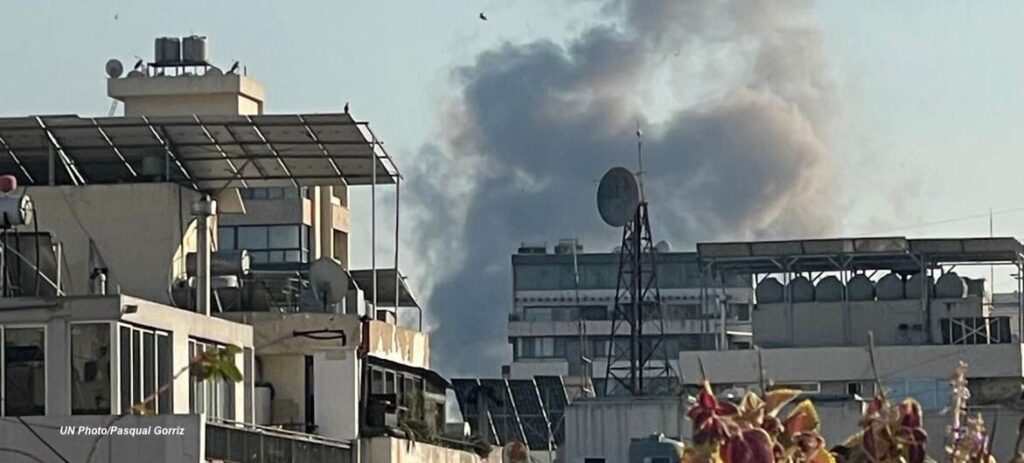
New York, 13 April 2026 – Failure by the United States and Iran to work out a solution to end the war in the Middle East has severely impacted on low-income countries while advanced economies can absorb the effects, particularly in the area of energy, the UN Development Programme (UNDP) said in a new analysis
“While shocks are global, impacts are unevenly distributed,” the 27-page analysis said in its executive summary. “Advanced economies can absorb the effects of energy shocks in ways that are unattainable for low-income and some middle-income economies because of major differences in fiscal and financial constraints. Countries in the Gulf region, Asia, Sub-Saharan Africa and SIDS (Small Island Developing States) are uniquely vulnerable.”
“Preliminary regional assessments from Europe and Central Asia reinforce this asymmetry. Although aggregate GDP effects in parts of the region may appeal limited, human development impacts could be substantial if shocks persist. A decline in HDI of just 0.005 point – half the magnitude observed during COVID-19 – would imply development setbacks ranging from under two years in some economies to more than seven years in more fragile contexts. This stresses that headline income levels do not necessarily equate with resilience, and that recovery capacity varies significantly across countries.”
“Effects of the crisis reach far beyond directly affected countries, falling hardest on the poor and most vulnerable. Targeted and temporary cash transfers are the preferred policy response for fiscally constrained countries.”
Following is a press release by UNDP: “Ongoing military escalation in the Middle East puts tens of millions of people at risk of falling into poverty across 162 countries.
While the impacts are concentrated in countries directly affected by the conflict and those dependent on imported energy, the findings point to significant longer-term harm to poorer countries far removed from the fighting.
The findings are published in a new policy brief – Military escalation in the Middle East: Reversals in global development, policy response options – that uses Global Trade Analysis Project (GTAP) modelling to assess economic impacts under scenarios ranging from short-lived disruption to prolonged shocks lasting eight months.
Now in its 6th week, and despite the temporary ceasefire, the impacts are evolving from an ‘acute’ to an ‘enduring’ phase. The longer this phase continues, the greater the risk of accelerated lapses into poverty in vulnerable countries, the brief reveals. Under the worst-case scenario, an additional 32 million people could be pushed into poverty.
Countries in the Gulf region, Asia, Sub-Saharan Africa, and Small Island Developing States are uniquely vulnerable, the brief reveals.
War is development in reverse. Conflict can undo in weeks what countries have built over years,” said UNDP Administrator and UN Under-Secretary-General Alexander De Croo. “This new analysis shows that the shock of the escalation of the conflict in the Middle East is not limited to the countries directly affected, but falls disproportionately on those with the least fiscal room to absorb higher energy and food prices. For these countries, the crisis forces impossible trade-offs between stabilizing prices today and funding health, education, and jobs tomorrow. That is unacceptable, and it is preventable. Early policy action matters.”
UNDP sets out policy options for countries to help mitigate the effects of the conflict under each projected scenario. Chief among these is a recommendation that policymakers consider targeted and temporary cash transfers to protect poor and vulnerable households as a first line of defense. Depending on the scenario, as much as US$ 6 billion in cash transfers would be needed for this measure to be effective.
Other recommendations include temporary and targeted subsidies or vouchers for minimum ‘consumption blocks’ of electricity or cooking gas. The brief cautions against blanket energy subsidies – widely used in developing economies – that disproportionately favour wealthier households over those most in need and are financially unsustainable over time.
The brief is part of a series of socio-economic analyses produced by UNDP on the impacts of the Middle East Crisis in Iran and the region to help policymakers understand the human development consequences and identify options for response. Further analysis covering the Asia-Pacific region is forthcoming. “
Media contact
For more information or to request an interview, please contact:
In New York City – Dylan Lowthian dylan.lowthian@undp.org +1 646 673 6350
United Nations correspondent journalists – United Nations correspondent journalists – United Nations journalism articles – United Nations journalism articles – United Nations News – UNCA Awards