
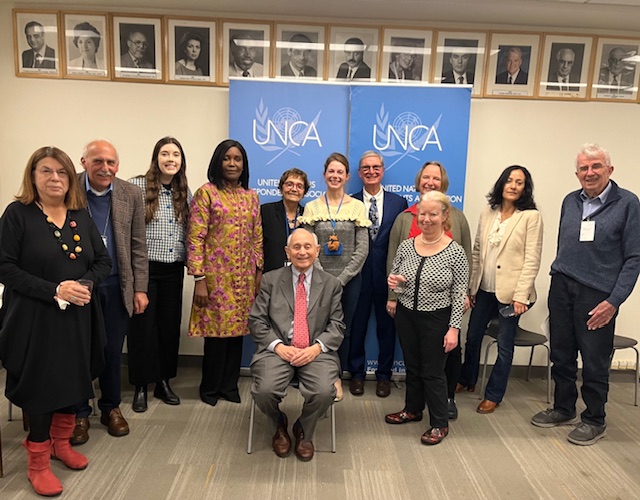
Note: While the UN is affected by funding cuts that have drastically reduced humanitarian activities worldwide, the United Nations Staff 1% for Development Fund has remained active like a “lighted candle in the darkness.”
By Pat Duffy and Johanna Stansfield
New York, 25 June 2025 – In these days of “UN austerity measures” that are affecting humanitarian aid worldwide (as UN Member States – especially large donor countries – are reducing their contributions), there is at least one lighted candle in the darkness: the continued small but steady efforts of the United Nations Staff 1% for Development Fund.
For over forty years, members of the Fund’s Management Committee have reviewed and selected projects proposed by community groups, mostly from Global South rural villages, where access to clean water, jobs and education is often scarce. In line with the Fund’s criteria, the projects must be income-producing and self-sustaining. The selected groups receive microgrants (capped at $5,000) to help implement and monitor the projects over a period of one to two years.
Since its creation in 1984 by a group of New York staff members, the Fund has given microgrants to help launch between five and eight projects a year. In 2023, the Fund approved microgrants for seven projects, in Togo, Ghana and Kenya, for a total of $34,370.
In Kenya, funds enabled a non-governmental organization to expand its vocational training program to teach men and women skills in carpentry, woodworking, motor vehicle mechanics, tailoring and dressmaking, electrical work and metalwork, by adding new power tools, including an electric lathe, two welding machines and two angle grinders, to its toolkit.
In Togo, funds were provided to buy a mill for grinding soybeans, corn and other grains and to provide training to a group of women on its use. The project helped reduce the women’s tedious and time-consuming work of milling by hand. Training was provided in business management, literacy skills and activities to generate income from the mill-processed goods. Providing such a vital service to their neighbors enabled the women to raise their status in the community and take on more leadership roles.
In 2024, the Fund was able to approve grants for only half the usual number of projects, for a total of $15,000. Contributions to the Fund were reduced as it lost members owing to retirement and increasing economic uncertainty regarding employment.
Among the 2024 grantees was a project to dig two boreholes (shallow wells) on the grounds of two elementary schools in rural Malawi to provide a clean water source for students and staff and village residents. The two boreholes cost $5,000 and helped to transform the lives of the local residents. They enabled girls, who often had to miss school in order to carry out their daily task of collecting water from faraway wells, to attend school on a more regular basis. Moreover, residents no longer needed to use impure nearby water sources, which could leave them vulnerable to such diseases as cholera, dysentery and malaria.
Over the years, the Fund has supported a range of other projects, including supplying goats to village women in India and Bangladesh. The women, who often lacked job skills, were able to earn income by raising goats and selling their milk to members of their communities.
The Fund’s two longest-running projects are the Kitengesa Community Library, a village library and community center in rural Uganda (funded in 2000), and “Esperanza”, a health clinic, educational center, and bee-keeping/honey enterprise in the Dominican Republic (funded in 1994). Both centers were launched thanks to the initial support of the 1% Fund and have since then expanded their services with grants from other sources.
The year 2024 marked the fortieth anniversary of the Fund in New York, which was celebrated through an event held at UN Headquarters in a space generously offered by the UN Correspondents Association. The renowned UN scholar, Stephen Schlesinger, gave an excellent presentation on the history and work of the UN, which led to a lively Q&A with the audience. The event was one of several “Authors-for-Literacy” events organized by the Fund to gain resources and members.
Moral philosopher and advocate for global development and Professor of Bioethics at Princeton University, Peter Singer, has also presented at a 1% Fund “Authors-for-Literacy” event. In a recent 2025 New York times article, Professor Singer advocates for continued support of charities in the face of reduced funding from conventional sources. To quote Singer: the best way to enable the continued funding of projects is “to support alternative financing models”.
The 1% Fund is one such model, small though it is.
All UN staff work towards the common goal of making the world a better place. Staff members can make an even more direct impact by joining the Fund. As the Fund is staffed by volunteers, there are no overhead costs, and 100% of contributions go towards funding projects. To support this vital work, UN staff members, both active and retired, are invited to become regular contributors, offering a minimum of $15 per month, which the Payroll Office can deduct directly from the staff member’s salary.
As Professor Singer explains in his book , The Most Good You Can Do: How Effective Altruism Is Changing Ideas About Living Ethically: “Most effective altruists are not saints but ordinary people like you and me… Some of them are content to know they are doing something significant to make the world a better place. Many of them like to challenge themselves, to do a little better this year than last year.”
Contact:
Alice Harrison, Convenor, UN One Percent for Development Fund, turtlerelease@yahoo.com
Samantha Fohmann, Treasurer, samantha.fohmann@un.org
Pat Duffy, member, Management Committee, PLduffy@gmail.com
Johanna Stansfield, member, Management Committee, johanna.stansfield03@gmail.com
United Nations journalists – United Nations journalists – United Nations journalists
United Nations News – United Nations News – UN Correspondents Association – UNCA Awards