

Note: The World Meteorological Organization (WMO) has issued a new report on the state of the world’s climate at the opening of the annual UN climate conference in Antalya, Turkiye. The report’s key messages warn that 2026 will be one of four warmest years on record. The messages are:
- El Niño turns up the heat and multiplies risks
- Sea level and ocean heat are at record high levels
- Extreme weather has massive economic and human cost
- Forecasts and warnings, underpinned by sustained observations, are vital
Antalya, Türkiye, 9 November 2026 – The year 2026 continues the protracted streak of exceptional global temperatures, melting ice and rising sea levels, with a very strong El Niño event set to unleash even more heat and extreme weather well into 2027, according to a new report from the World Meteorological Organization (WMO). It highlights the knock-on risks to the environment, economy, and everyday life.
The WMO State of the Climate Update 2026 shows that the past 12 years have individually been the warmest on record, with the past four years being the top four. The global average surface temperature for January–September 2026 was about 1.47 °Celsius above the pre-industrial average. This figure is likely to rise through the end of the year because of the warming effect of El Niño, which has been intensifying since August and is expected to be the strongest on record by December.
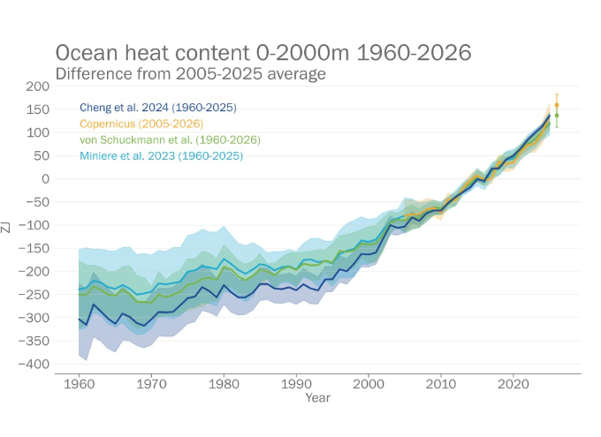
Earth’s energy imbalance is rising and the earth system is accumulating heat at an accelerating rate. The imbalance reached its highest level since monitoring began, as greenhouse gases trap unprecedented amounts of heat and upset the equilibrium between incoming energy from the sun and outgoing energy. The ocean absorbs 90% of this excess heat and 2026 is on track to be the tenth successive year of record ocean warmth.
Sea level is the highest on record, and sea-surface temperatures hit monthly records during 2026. The long-term retreat of glaciers continues – the annual mass loss of ice in 2025 would have filled five Olympic pools every second of the year. Freshwater storage has been dwindling since 2014.
“We have entered a new age of climate extremes. A supersized El Niño is colliding with a planet already superheated by manmade climate change. Climate records keep falling. The human costs keep rising. And those least responsible are suffering first and worst. Leaders must get serious by cutting emissions faster, accelerating a just transition from fossil fuels and delivering the finance and protection vulnerable countries need.” said UN Secretary-General António Guterres.
“El Niño and indeed the state of the global climate in 2026 gives new meaning to the phrase off the charts. El Niño doesn’t add new heat to the planet. It releases heat from the ocean, which is the warmest ever measured. There is simply more heat available to release,” said WMO Secretary-General Celeste Saulo.
“We are supercharging our weather and El Niño will be a risk multiplier. Heatwaves, tropical cyclones, and rainstorms are intensifying faster than our historical baselines prepared us for. Hundreds of millions of people this year have been exposed to unbearable extreme heat, whilst the catastrophic ice and rock collapse and flash floods in Nepal highlighted the compound risks facing communities in fragile, warming high-mountain terrain.”
Forecasts underpinned by sustained observations from every part of the world are more important than ever to monitor our rapidly changing climate and help navigate the increasing risks to societies and economies. The good news is that the number of countries reporting the existence of multi-hazard early warning systems (MHEWSs) has increased from 56 in 2015 to 136 in 2025, according to the report.
The WMO State of the Climate 2026 Update was released on the first day of COP31 in Antalya, Türkiye, as an authoritative, science-based report. It includes data – where available – up to September 2026 and therefore does not reflect the most recent impacts of El Niño.
The final State of the Global Climate 2026 report will be issued in March 2027, incorporating scientific contributions from dozens of National Meteorological and Hydrological Services, regional climate centres, United Nations partners and experts from the WMO community.
Highlights
Global temperature: The global mean near-surface temperature anomaly averaged from January to September 2026 (1.47 °C ± 0.13 °C above the 1850–1900 average) is comparable to the whole-year averages for 2025 (1.43 °C) and 2023 (1.46 °C) and lower than the 2024 record (1.55 °C). This is based on nine internationally recognized datasets. The past four years, 2023-2026, are the four warmest years on record.
La Niña conditions at the start of the year had a temporary cooling effect, which was reversed by the development of El Niño. Global monthly average sea-surface temperatures were the highest or second highest on record for June, July and August, and monthly global temperatures were among the three highest for the time of year from May to September.
El Niño is forecast to continue into early 2027. El Niño typically boosts annual global mean temperatures by around 0.1 °C–0.2 °C, and it is likely that the final anomaly for 2026 will be higher than the January to September average. El Niño typically has the greatest impact on global average temperatures in the year after its development.
Greenhouse gas levels reached a new record in 2025. Atmospheric concentration of carbon dioxide has increased by 53% from around 278 parts per million (ppm) in 1750 to about 426.8 ppm in 2025. Global averaged methane concentrations increased from 729 parts per billion (ppb) in 1750 by 167% to 1 948 ppb in 2025. Nitrous oxide concentrations increased by 26% from 270 ppb in 1750 to 339.1 ppb in 2025.
Measurements from benchmark monitoring stations (such as Mauna Loa in Hawaii and Kennaook/Cape Grim in Australia), indicate a continued increase in 2026. El Niño events typically lead to a surge in greenhouse gas concentrations.
Earth’s energy imbalance: Ocean heat measurements and satellite observations show an acceleration in the rate at which the Earth system is accumulating heat. In 2025, it reached its highest observed value since monitoring began in 1960. Preliminary values for January–July 2026 suggest another record high.
Ocean heat content in the upper 2 000 meters was the highest in the observed record in 2025 and has continued to rise in 2026, according to preliminary data (to July). Ocean warming rates have accelerated with a particularly strong increase over the past two decades, impacting marine ecosystems, biodiversity, and the ocean’s role as a carbon sink. Ocean heat intensifies tropical and subtropical storms, accelerates sea-ice loss in the polar regions, and – together with melting land ice – drives sea-level rise. This warming is projected to continue for hundreds to thousands of years.
Global mean sea level reached a record high in 2026. Sea-level rise has accelerated since the start of the satellite record as a result of increased melting of glaciers and ice sheets, as well as increased thermal expansion of warming waters. June, July and August 2026 saw their highest values since the beginning of the satellite altimetry era in 1993. This sharp increase may reflect changes associated with the developing El Niño, including a shift in rainfall from land to ocean in the western tropical Pacific.
Sea ice: In 2026, Antarctic sea ice reached its third-lowest annual maximum on record (in the satellite era since 1979), while the Arctic maximum was the lowest or second lowest. Sea ice plays an important role in the global climate system and polar ecosystems.
Glaciers lost more than 400 gigatons of ice in 2025 – equivalent to approximately 1 mm of sea-level rise. This annual mass loss would have filled five Olympic pools every second of the year. 2025 marked the fourth consecutive year in which all 19 glaciated regions around the world suffered ice loss. The melting of glaciers has implications for local and downstream geohazards, ecology, regional water resources and water quality, as well as global energy and sea-level budgets.
Freshwater: Water stored on land (in groundwater, soil, rivers, reservoirs, glaciers and snow) has declined globally since 2014. In 2025, 42% of the assessed global area had below-normal terrestrial water storage, compared to the long-term average of 25%.
Extreme events impacted lives and livelihoods, undermined food security, deepened poverty and contributed to displacement across multiple regions. The European heatwaves, drought and wildfires led to more than 30,000 excess deaths, according to preliminary estimates, with national temperature records in at least eight countries, and major impacts on agriculture, energy and transport.
An estimated 146.5 million people in India were exposed to extreme heat in an April 2026 heatwave. The Himalayan glacier collapse and catastrophic downstream flash flood in late August killed more than 1,300 people and had a massive impact on Nepal’s economy.
Tropical cyclones caused devastation and loss of life in many countries.
The current El Niño is expected to act as a risk multiplier for health. Increased heat, drought and heavy rainfall can contribute to heat-related illness and mortality, wildfire smoke and poor air quality, malnutrition and food insecurity, injuries, and changing risks of water- and vector-borne diseases such as cholera, malaria and dengue. The World Health Organization (WHO) has, for the first time, classified the anticipated health impacts as a health emergency.
El Niño is already increasing risks for agriculture in key seasons and production systems, especially in areas where there is high food insecurity and heavy reliance on rainfed agriculture.
The World Meteorological Organization is the United Nations System’s authoritative voice on Weather, Climate and Water.
For further information, please contact:
- Clare Nullis, WMO media officer, cnullis@wmo.int +41 79 709 13 97
- Global Communication and Engagement Media: Contactmedia@wmo.int
United Nations correspondent journalists – United Nations correspondent journalists – United Nations journalism articles – United Nations journalism articles – United Nations News – UNCA Awards