


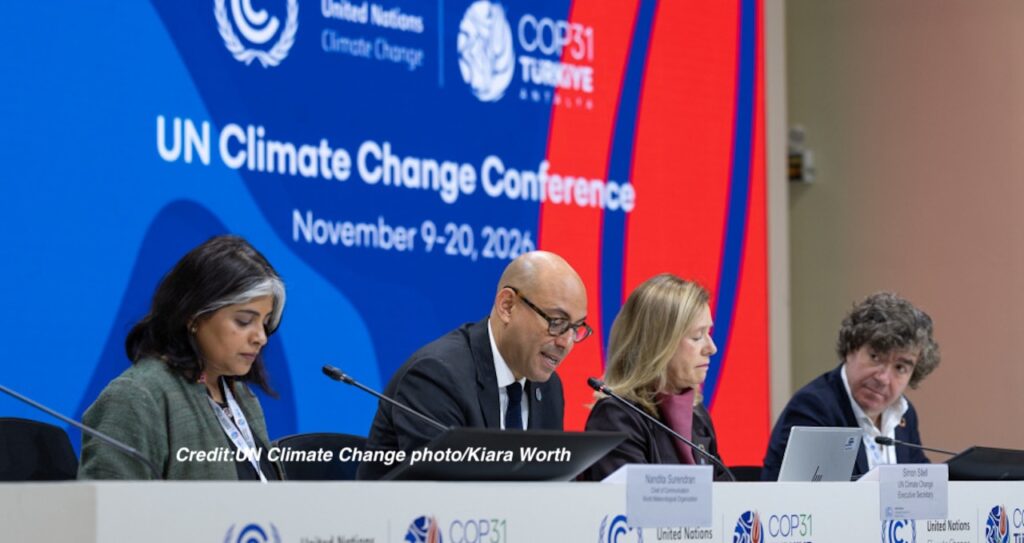
Antalya, Türkiye, 11 November 2026 – The United Nations called on countries attending its 31st climate change conference to implement a pledge to build more electric buses, cars and trucks, more efficient electric heating and cooling, and more industries powered by clean electricity by 2030.
With over 68,000 people that have registered to attend the 9-20 November climate change conference, known as COP31, at the Turkish Riviera city of Antalya, including official representatives from some 200 countries, UN Secretary-General Antonio Guterres said he welcomed the ambition of the 35-by-35 Global Electrification Pledge by the participants and he urged them to “make it real and make it clean.”
“The crises in the Middle East has once again exposed the price of fossil fuels dependence,” he told the high-level dialogue on clean energy transition and electrification.
He said the pledge calls for accelerating clean electrification and the transitioning away from fossil fuels, build the grids and storage to power the clean energy age, and make clean electricity affordable and available to all.
“Fossil fuels have failed to deliver on universal energy access,” he said. “Hundreds of millions of people still live without electricity. They cannot be left behind by the clean energy revolution. The geography of the energy transition is shifting.”
“The case for fossil fuels is collapsing,” Guterres said in another address to the conference. “Three-quarters of humanity live in countries that import fossil fuels. Hostage to price shocks they did not create and cannot control. Recent conflicts make clear that this is a recipe for chronic insecurity and a cost-of-living meltdown. It is time to accelerate a science-aligned, just orderly and equitable phase-out.”
He called for an “extraordinary acceleration” to clean energy as the planet is heating up and the climate crisis has triggered “now a global health crisis of pandemic proportions.”
Simon Stiell, the UN Climate Change Executive Secretary, said when he opened the conference on 9 November that the world is getting “dangerously hot. Hundreds of millions of people exposed to extreme heat across southern Asia.”
Citing a newly published report on the global temperatures by the World Meteorological Organization, Stiell said, “Heatwaves in the northern summer smashed temperature records, and killed an estimated 50,000 people across Europe. For too many people, climate change is deadly. A super El Niño is turbocharging climate impacts, delivering a deadly double-blow. The climate crisis is now a global health crisis of pandemic proportions. From toxic pollution to extreme heat, and climate disasters slamming through health systems and infrastructure.”
COP31 began work to rein in global climate problems against a background of severe climate extremes, global warming exceeding the 1.5 degrees Celsius and 2026 is declared one of four warmest years so far.
Stiell said rising heat has a dangerous impact on pregnancy, newborns and maternal health are “another unfolding health disaster which has the fingerprints of the climate crisis all over it. The root cause is humanity still burning colossal amounts of coal, oil and gas, and destroying forests.”
The UN said COP31 aims at driving forward “practical solutions which make a real-world difference.” Health is central to the conference and it is looking for solutions and funds to meet demands around the world. It said negotiations will take place during the conference to advance programs assisting countries to adapt to climate impacts and reduce greenhouse gas pollution.
It said cooperation between nations is essential to solve global climate crises and negotiations have already made significant progress bringing down global heating projections from over 4 degrees Celsius to 2.6 degrees. But more and faster action is needed to protect all people and economies.
WFP urges COP31 to use innovative finance to prevent climate shocks from becoming hunger emergencies
As COP31 begins, the UN World Food Programme (WFP) warned in a press release (9 November) that humanitarian assistance alone cannot keep pace with recurrent crises caused by increasingly frequent weather extremes and a strengthening El Niño. Communities have little time to recover between shocks, which is why WFP is calling on leaders to deliver sustained investment through innovative financial solutions that prevent predictable weather-related hazards from becoming hunger emergencies.
Areas already affected by conflict and economic instability face climate shocks that risk pushing millions more people into acute food insecurity. WFP analysis projects that the current El Niño could push at least 49 million more people into acute food insecurity by the end of 2027. The phenomenon is expected to reach peak intensity between October and December 2026, while its impact on planting seasons, harvests and food prices could continue into early 2028.
These risks are already visible across regions. Drought is affecting growing seasons in Central America’s Dry Corridor, while parts of the Sahel and East Africa are also experiencing severe dryness. Southern Africa faces the threat of drought during a crucial growing season, while heavy rain and flooding could affect the Horn of Africa and parts of South America.
“With floods, droughts and storms striking so often, vulnerable families have little time to recover,” said Carl Skau, WFP’s Deputy Executive Director and Chief Operating Officer. “El Niño will intensify that pressure, but because it can be predicted, we have a chance to act before crops fail, livelihoods are lost, and hunger sets in. COP31 must seize this window and turn it into faster, more accessible financing for the countries and communities on the front lines of disasters.”
WFP is the UN’s largest user of pre-arranged financing, drawing on anticipatory action, insurance, and contingency funding to deliver support before or immediately after an emergency. At COP31, WFP is working closely with other UN agencies to scale-up pre-arranged financing and strengthen collaboration, with the aim of lowering costs and making scarce resources go further.
WFP is acting before shocks hit. Between January and September, WFP reached 4.9 million people with early warnings and provided more than 1.5 million with assistance ahead of forecast floods, storms, and droughts, backed by US$46.2 million in pre-arranged funds.
However, these approaches remain far below the scale required. Pre-arranged mechanisms account for less than two percent of global humanitarian financing.
WFP is calling on leaders at COP31 to: Scale up predictable, pre-arranged financing that can be released before forecasted hazards escalate into disasters. Make finance more accessible to fragile, conflict-affected and highly food-insecure countries. Invest in nationally led early warning, anticipatory action, disaster risk management, and shock-responsive social protection systems.
United Nations correspondent journalists – United Nations correspondent journalists – United Nations journalism articles – United Nations journalism articles – United Nations News – UNCA Awards