


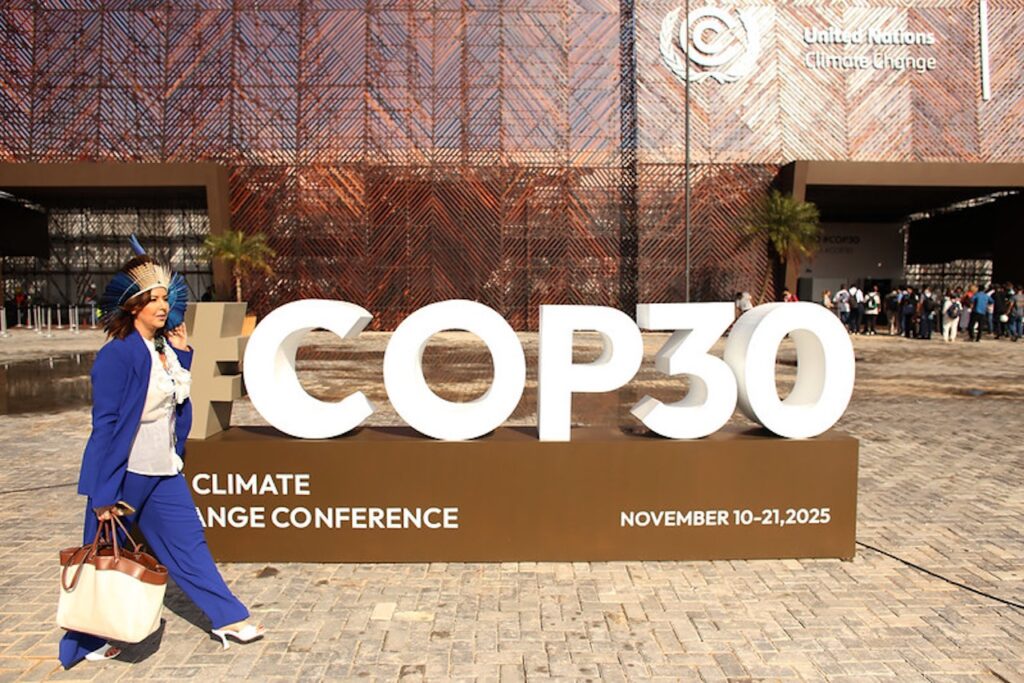
Belem, Brazil/New York, 9 November 2025 – Government leaders and civil society organizations as well as climate scientists have begun once again each year the difficult task of convincing nations across the world to switch from fossil fuels to green energy to keep global temperatures at 1.5 degrees Celsius to avert climate disasters as many parts of the world have experienced.
But some of the world’s top carbon polluters failed to send high-ranking government decision makers to attend preliminary discussion of the 30th climate conference which this year is held at the Amazon city of Belem (10-21 November). The United States under the Trump administration rejected the green energy concept and boycotted the high-level meeting while China and India sent government ministers to the meeting. The three countries are responsible for more than 50 per cent of the world’s heat trapping carbon dioxide from burning of coal, oil and natural gas. President Donald Trump pulled the US out of the 2015 Paris Agreement, which set 1.5 degrees as global temperatures.
“Science tells us it is still possible to keep temperature rise below 1.5 degrees Celsius by the end of the century,” UN Secretary General Antonio Guterres told the Belem conference before its official opening on November 10. “Yet, a temporary overshoot above 1.5 degrees, starting, at the latest, in the early 2030s, is now inevitable. But we can manage the scale and duration of that overshoot and bring temperatures back down – if we take serious action now. “
Guterres said countries are required to take deep emissions cuts of 60 per cent by 2035 to stay on track to meeting 1.5. He said the 1.5° C limit remains “a red line for humanity”, calling for rapid emissions cuts, an accelerated phase-out of fossil fuels, and stronger protection of forests and oceans. He pointed out the growing global momentum of the clean energy revolution while investments in renewables have now exceed those in fossil fuels by $800 billion.
“Clean energy is winning in price, performance, and potential,” he said, “but what is still missing is political courage.”
The UN said green energy sources now accounted for 90 per cent of new power capacity last year, while investment in them reached $2 trillion, or $800 billion more than fossil fuels.
“The renewables revolution is here,” Guterres said while pointed out that “To return below 1.5 degrees by century’s end, global emissions must fall by almost half by 2030, reach net zero by 2050, and go net negative afterwards.”
World faces serious climate crisis and damages despite efforts to keep global temperatures low
A UN Environment Program assessment of available new climate pledges under the Paris Agreement finds that “the predicted global temperature rise over the course of this century has only slightly fallen, leaving the world heading for a serious escalation of climate risks and damages.”
UNEP said in its Emissions Gap Report 2025: Off Target, issued before the Belem conference, which finds that global warming projections over this century, are now 2.3-2.5°C, compared to 2.6-2.8°C in last year’s report. Implementing only current policies would lead to up to 2.8°C of warming, compared to 3.1°C last year.
“The report finds that the multi-decadal average of global temperature rise will exceed 1.5°C, at least temporarily. This will be difficult to reverse – requiring faster and bigger additional reductions in greenhouse gas emissions to minimize overshoot, reduce damages to lives and economies, and avoid over-reliance on uncertain carbon dioxide removal methods,” the Nairobi-based UN agency said in a press release.
“Nations have had three attempts to deliver promises made under the Paris Agreement, and each time they have landed off target,” said Inger Andersen, Executive Director of UNEP. “While national climate plans have delivered some progress, it is nowhere near fast enough, which is why we still need unprecedented emissions cuts in an increasingly tight window, with an increasingly challenging geopolitical backdrop.”
“But it is still possible – just. Proven solutions already exist. From the rapid growth in cheap renewable energy to tackling methane emissions, we know what needs to be done. Now is the time for countries to go all in and invest in their future with ambitious climate action – action that delivers faster economic growth, better human health, more jobs, energy, security and resilience.” (By J. Tuyet Nguyen)
United Nations journalists – United Nations journalists – United Nations journalists
United Nations News – United Nations News – UN Correspondents Association – UNCA Awards