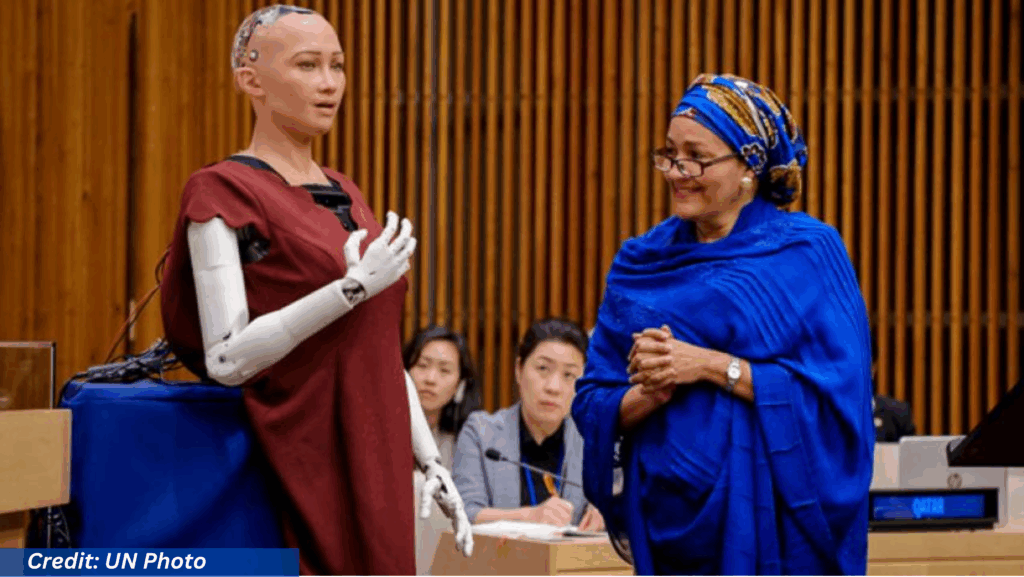
New York, 27 September 2025 – The United Nations will ask governments around the world to nominate experts for the 40-member scientific panel established by the UN General Assembly to draw up red lines as artificial intelligence offers opportunities as well as risks. The project puts the UN at the center of competition for global AI leadership.
The decision by the Assembly, which comprises 193 countries, is backed by organizations that share the views that AI use without guardrails may lead to dangerous consequences. The AI Red Lines group (see www.red-lines.ai) has issued a statement with the headline: “We urge governments to reach an international agreement on red lines for AI — ensuring they are operational, with robust enforcement mechanisms — by the end of 2026.”
“AI holds immense potential to advance human wellbeing, yet its current trajectory presents unprecedented dangers. AI could soon far surpass human capabilities and escalate risks such as engineered pandemics, widespread disinformation, large-scale manipulation of individuals including children, national and international security concerns, mass unemployment, and systematic human rights violations,” the group said.
The statement – with nearly 300 signatories, including 10 Nobel Prize laureates and recipients, 70 organizations and 200 prominent personalities – said some advanced AI systems have already exhibited “deceptive and harmful behavior,” yet they are given autonomous functions.
“Governments must act decisively before the window for meaningful intervention closes. An international agreement on clear and verifiable red lines is necessary for preventing universally unacceptable risks. These red lines should build upon and enforce existing global frameworks and voluntary corporate commitments, ensuring that all advanced AI providers are accountable to shared thresholds.”
The UN said it will form the panel to synthesize and analyze the research on AI risks and opportunities, in the vein of previous similar efforts by the body on climate change and nuclear policy, as reported by UN News.
The UN Security Council has a “distinct role to play” regarding AI – The Council, comprising 15 nations including the world’s five powers – the US, Russia, China, France and United Kingdom – held a meeting on September 24, convened by South Korean President Lee Jae Myung to discuss issues related to AI. South Korea holds the rotating presidency of the council in September.
UN Secretary General Antonio Guterres, who backed the 40-member panel, told the council, “The question is not whether AI will influence international peace and security, but how we will shape that influence.”
When it functions properly and is responsible, AI can strengthen prevention and protection for anticipated food insecurity and displacement; supporting de-mining; helping identify potential outbreaks of violence and much more.
“But without guardrails, it can also be weaponized,” Guterres said, citing
AI-enabled cyberattacks that can disrupt or destroy critical infrastructure in minutes and its ability to fabricate and manipulate audio and video threatens information integrity, fuels polarization, and can trigger diplomatic crises.
The UN chief said the Independent International Scientific Panel on Artificial Intelligence and an annual Global Dialogue on AI Governance organized by the UN in August this year represented “a recognition of the unique convening power of the UN. Together, these initiatives aim to connect science, policy and practice; provide every country a seat at the table; and reduce fragmentation.”
“I will soon launch an open call for nominations for the Scientific Panel,” he said and urge governments to nominate eminent and diverse experts, and provide support the panel’s expertise, independence and regional balance.
The UN General Assembly, while holding its 80th session in September with more than 140 heads of state and government attending, said it was implementing a “global dialogue on artificial intelligence governance,” to assemble ideas and best practices on AI governance. It also announced a plan to establish itself as the leading global forumto guide the path and pace of artificial intelligence, a major foray into the raging debate over the future of the rapidly changing technology.
The Security Council’s debate on AI on September 24 was part of its responsibility on the maintenance of international peace and security. It said it has a “distinct role to play” on AI use where it intersects with its responsibility. It said AI has emerged as one of “the most consequential technological revolutions in modern history, rapidly transforming every aspect of human activities across both military and civilian domains.”
One participant in the council meeting was Yejin Choi, Senior Fellow at Stanford University’s Institute for Human-Centered Artificial Intelligence, who told the body that current progress in AI is too concentrated among a handful of companies and countries, as reported by UN News.
“When only a few have the resources to build and benefit from AI, we leave the rest of the world waiting at the door,” she said. “Let us expand what intelligence can be – and let everyone everywhere have a role in building it.”
Ms. Choi urged governments and international institutions to invest in alternative approaches beyond scaling ever-larger models, arguing that smaller, more adaptive systems could lower barriers to entry. Let us expand what intelligence can be, and let everyone have a role in building it
She also pressed for stronger representation of linguistic and cultural diversity, noting that today’s leading AI models “underperform for many non-English languages and reflect narrow cultural assumptions.”
Yoshua Bengio, from the Canadian AI institute MILA, said: “If scientifically observed trends continue, some AIs could surpass humans across most cognitive tasks in as little as five, maybe 10, years. This would be a radical change in the history of mankind. Scientists still do not know how to design AIs that will not harm people, that will always act according to our instructions and comply with human rights and human dignity. Advances in AI will offer ways to tackle some of society’s biggest challenges. Yet they will also introduce major risks to international peace and security.”
(By J. Tuyet Nguyen)
United Nations journalists – United Nations journalists – United Nations journalists
United Nations News – United Nations News – UN Correspondents Association – UNCA Awards