
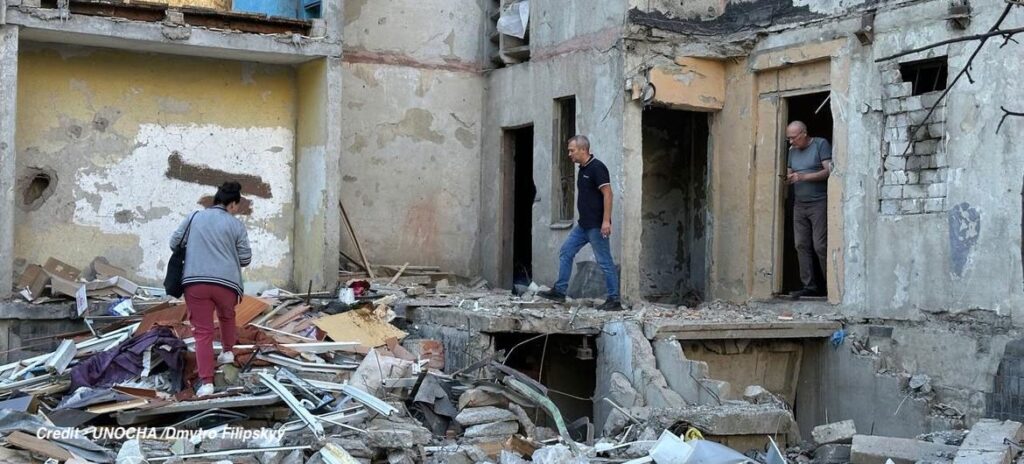
New York, 23 March 2026 – United Nations officials said the war in Ukraine is far from abating after four years and civilian casualties have increased while millions of Ukrainian refugees living abroad and those displaced inside the country survive thanks to humanitarian assistance provided mostly by the European Union.
“The war in war in Ukraine is over four years since the Russian Federation’s full-scale invasion of Ukraine, nearly 1500 days of death, destruction and despair,” Under Secretary-General Rosemary DiCarlo told the UN Security Council in a meeting on the humanitarian situation in Ukraine. “And today, far from abating, the violence is worse than ever.”
DiCarlo said the Office of the High Commissioner for Human Rights (OHCHR) has verified since February 2022 that 15,364 civilians, including 775 children, have been killed in Ukraine. In addition, 42,144 civilians, including 2,588 children, have been injured while the actual number of casualties is likely significantly higher.
She said in February this year at least 188 civilians were killed and 757 injured – a 45 per cent increase compared to same period last year. “As the conflict drags on, we commend the countries that are still hosting millions of Ukrainian refugees for their continuing support.”
She said there are still over 6.7 million refugees from Ukraine globally and more than 3.7 million people are displaced inside Ukraine. She praised the EU’s extension until March 2027 of protection measures for the refugees as conditions do not allow for their return now.
DiCarlo said for long-term international support is also needed for Ukraine’s recovery and reconstruction as total war damage has reached an estimated US$195 billion and Ukraine would require US$ 588 billion over the next decade for recovery and reconstruction.
Tom Fletcher, the Under Secretary-General for Humanitarian Affairs and Emergency Relief Coordinator, said civilian casualties in Ukraine “far exceed levels this time last year” as they civilians continue to face waves of drone and missile strikes, destroying homes, schools, and hospitals.
“Entire communities are being forced to flee as hostilities intensify along front-line areas. For children, this means missed schooling, prolonged stress and fear, and separation from loved ones,” he said. “At the same time, many civilians – including older people and those with limited means – remain in high-risk areas.”
Fletcher said strikes on energy and other vital infrastructure “reflect a sustained pattern of damage to the systems on which civilians depend to survive, with humanitarian aid increasingly stepping in to fill the gaps left by the deterioration of essential services. This is a population under constant strain, where the damage builds quietly but relentlessly alongside the visible destruction.”
Fletcher asked the 15-nation Security Council to uphold international humanitarian law in the war and ensure safe, rapid, and unimpeded humanitarian access to all civilians in need wherever they are.
“Our access in Russian-occupied areas remains severely constrained, limiting our ability to assess needs or deliver help to civilians,” he said, adding that his department’s 2026 Humanitarian Needs and Response Plan requires US$ 2 billion to reach 3.6 million of the most vulnerable people with food, heating, medical care, and protection. But he said nearly three-quarters is unfunded.
“Fund the response, so that we can deliver life-saving aid at the scale and speed needed,” he said.
United Nations correspondent journalists – United Nations correspondent journalists – United Nations journalism articles – United Nations journalism articles – United Nations News – UNCA Awards