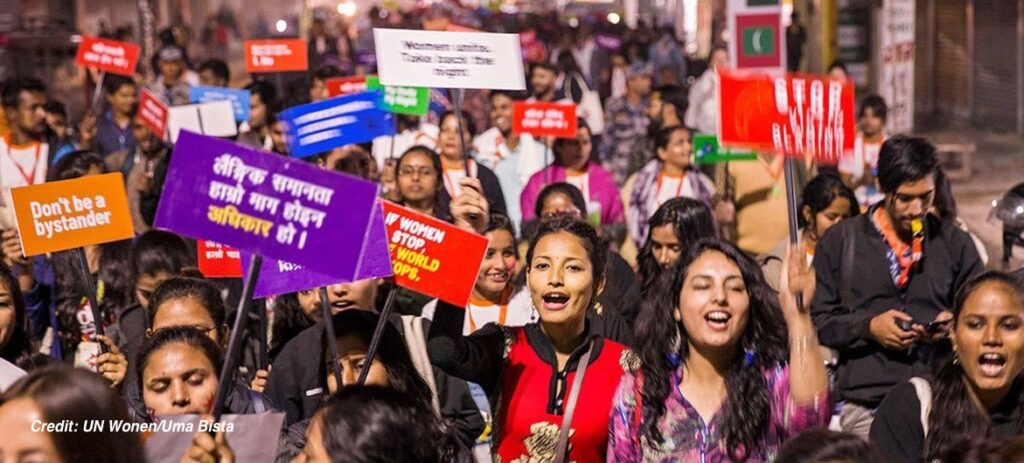
New York – 10 March 2026 – The United Nations marked the International Women’s Day this year while the Commission on the Status of Women (CSW) began its annual meeting at UN Headquarters and has adopted a set of Agreed Conclusions to strengthen access to justice for all women and girls.
CSW is the UN’s principal intergovernmental body dedicated to advancing gender equality and women’s empowerment globally. Established 70 years ago, the Commission held its meetings in New York attended by delegations of women from around the world under the theme “Rights. Justice. Action.” The UN celebrates the International Women’s Day 9 March each year and the CSW meets 9-19 March.
The Commission said the Agreed Conclusions aimed at “Ensuring and strengthening access to justice for all women and girls, including by promoting inclusive and equitable legal systems, eliminating discriminatory laws, policies, and practices and addressing structural barriers.” The Agreed Conclusions are considered a global policy to guide governments, UN agencies and non-governmental organizations on gender equality issues.
The commission said the Agreed Conclusions were adopted with 37 votes in favor against one (the United States) with six abstentions: Côte d’Ivoire, Egypt, Mali, Mauritania and Saudi Arabia.
UN Secretary-General Antonio Guterres said in an address opening the meeting that
the CSW has been from the beginning a “meeting ground of frontline defenders. A wellspring of conviction, passion, and energy. And a global platform for truth-telling.”
“So let me begin with an often unspoken, but age-old, truth: We live in a male-dominated world and a male-dominated culture. Gender equality is – and always has been – a question of power.
He said, “Not a single step forward for women’s rights has ever been given. It has been won. Won by generations of women and girls, advocates and activists, community
leaders and justice seekers. Won by you.”
The UN Chief said women around the globe hold only 64 per cent of the legal rights enjoyed by men. ”In a world strained by conflict, climate chaos, widening inequalities and technological upheaval, the pushback on women’s rights is in overdrive,” he said. “Hard-won legal protections are being eroded.”
“Yet, over 40 countries have amended constitutions to advance women’s rights; 90 per cent have strengthened laws against violence. “The world is changing because women are changing it. But we have barriers to overcome and gaps to fill – opportunity gaps, implementation gaps, justice gaps.”
Governments reach a powerful global agreement to strengthen access to justice for all women and girls, UN Women Executive Director says
New York – As the largest United Nations convening dedicated to gender equality and women’s rights opens today, governments meeting at the 70th Session of the Commission on the Status of Women (CSW70) have adopted by broad consensus a powerful set of Agreed Conclusions aimed at strengthening access to justice for all women and girls and advancing gender equality worldwide.
Through this negotiated outcome, global leaders reaffirmed that access to justice is a transformative force for women and girls, which advances equality and non-discrimination, protects against violence and abuse, and strengthens trust in institutions. The Agreed Conclusions provide a roadmap to build more inclusive governance, support peace and social cohesion, and prevent future violations.
Welcoming its adoption, Under-Secretary-General and Executive Director of UN Women Sima Bahous said: “I applaud the delegations that have worked tirelessly to reach these Agreed Conclusions. They represent an important commitment to advancing access to justice for women and girls, ending impunity, and building justice systems that work for everyone, equally. By coming together, governments are once again demonstrating to the world what this Commission can achieve – and what our multilateral system can deliver for women and girls.”
The Chair of the Commission on the Status of Women, Ambassador Martiza Chan of Costa Rica, reflected on the importance of carrying these commitments forward beyond the session, noting: “We came here to commemorate, and we’re leaving with something harder to carry – responsibility.
Every woman who spoke to us today carried a single message: behind every statistic is a life, behind every negotiating position, is a woman or girl waiting to see if we mean what we say.”
“The answer depends on political will”, she concluded.
Media enquiries
media.team@unwomen.org
United Nations journalists – United Nations journalists – United Nations journalists
United Nations News – United Nations News – UN Correspondents Association – UNCA Awards