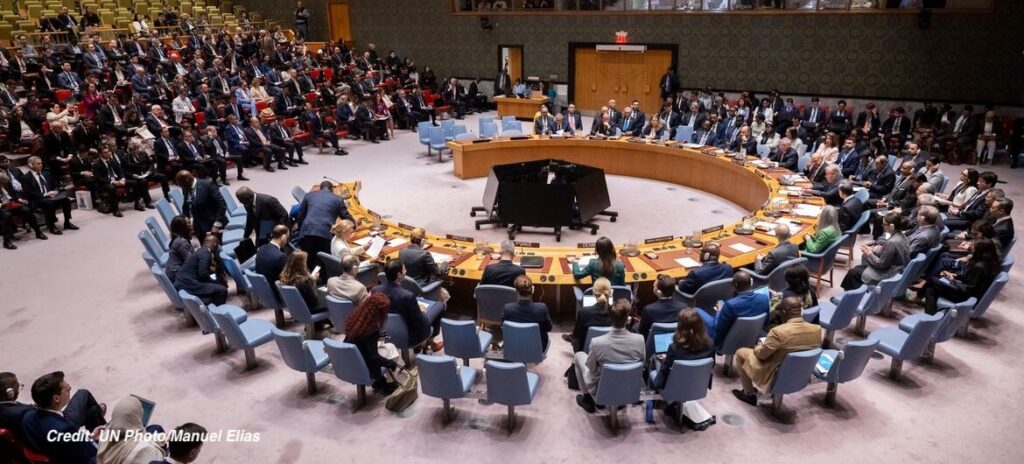
New York, 26 May 2026 – Government officials attending a debate in the United Nations Security Council, which is responsible for the world’s peace and security, tried to salvage the organization as wars and division have already diminished the importance of the organization’s charter and mission.
The council held a high-level meeting attended by ministers of foreign affairs to defend the UN Charter, reform the global governance and restore confidence on the UN Security council, which is deeply divided among the five permanent members – the US, UK, Russia, China and France. The council comprises also 10 countries elected to serve two year-terms.
UN Secretary-General Antonio Guterres told the meeting that the world is witnessing a dangerous erosion of respect for international law. He said the UN core principles – sovereign equality, territorial integrity, political independence, the prohibition of the threat or use of force – “are being challenged or ignored.”
“Violations go unanswered,” he said. “Impunity is spreading, geopolitical divisions are deepening, mistrust is growing, consensus is harder to achieve.”
He lambasted the 15-nation council, which he said “too often fails to act with unity and purpose. When the Security Council is divided, the consequences are felt far beyond this chamber “and as a result “conflicts are proliferating and intensifying. We now face the highest number of conflicts since the founding of the United Nations.”
He said conflicts are growing and expanding “in scale and complexity” in the Middle East, Ukraine, Sudan and beyond, and the world is witnessing growing numbers of external interference that provide weapons such as drones which target also civilians and civilian objects.
China’s Foreign Minister Wang Yi, who led the council meeting as China holds the presidency in May, said, “The giant ship of human civilization is sailing into dangerous waters – and world peace and development is at a dangerous crossroads. Today’s challenges are testing the international community’s commitment to safeguarding peace, its resolve to stand up for justice and its courage to take bold reforms.”
“We must stand united and act together to defend, to revitalize and to strengthen the United Nations. We must reinvigorate the UN Charter for stronger leadership.” he said, adding that the Charter remains the biggest common denominator of the post-war international community.
“We must strengthen the authority of the Security Council for greater ability to act,” Wang said pointing out that the council is “the most authoritative and legitimate body in the multilateral security system.” Wang urged that council to improve its working methods including rules of procedure and ensure that its proposals are “objective, impartial and inclusive” and avoid “forcing through” contentious initiatives.
Michael George DeSombre, Assistant Secretary of State for East Asian and Pacific Affairs of the United States, said the US helped found the UN in 1945 “to prevent global conflicts and promote international peace and security. We remain deeply invested in that mission today.” DeSombre said the Trump administration has since January 2025 taken “decisive and significant action to address these shortcomings,” in the UN and “has led efforts to get the UN back to its basic mission of maintaining international peace and security.”
“In practice, that includes streamlining the bureaucracy, eliminating duplication, and ensuring accountability for a more effective UN,” he said. “Under President Trump’s leadership, U.S. foreign policy is no longer beholden to a network of international institutions that are often driven by transnationalism that seeks to dissolve individual state sovereignty. Instead, we are focused on results. In the Security Council, we are putting these words into action.”
“The United States has played a central role in shaping the international order and multilateral institutions. What we are working towards is not a rejection of multilateralism, but putting clarity and results over inefficiency and hollow words. We will continue to work to advance the founding principles of the UN Charter,” he said. “We call on those whose actions undermine the UN Charter—including, at times, permanent members of this Council—to change course immediately.
Ambassador Jérôme Bonnafont of France said the erosion of international law and growing number of conflicts are the result of recklessness, UN News reported. Bonnafont said the illegal use of force and breach of international humanitarian law is reflected in the war of aggression waged by the Russian Federation against Ukraine – done so with “a lack of knowledge about the purposes and principles of the United Nations and rulings of the International Court of Justice”.
He condemned Moscow’s indiscriminate actions against civilians in Kyiv and other areas, as well as its targeting of communities and foreign embassies. He also accused the Russian representative of engaging in “inappropriate and mendacious verbal attacks” against France and Germany.
Ambassador Vassily A. Nebenzia of the Russian Federation, said the UN Charter is “a unique document” that “despite mushrooming risks and challenges” has spared the world another global war,Nebenzia said, as reported by UN News. “Yet today, the world is bearing witness to “ubiquitous breaches”, with attempts to cast doubt on the Charter’s value and obligation to comply therewith.
He accused the West of proposing a rules-based order which they both designed and have portrayed as universal. He denounced the disregard and contempt shown for the Charter – “the cornerstone document” – which today has reached itspeak.”Western elites” have shed any qualms about using brute force for the advancement of their political and economic interests. He accused them of hunting for resources and influence in their former colonies, engaging in an open fight against inconvenient sovereign countries, imposing new spaces in Asia and NATO-centric unions which threaten to undermine collective security. “Our duty is to cherish the Charter,” he insisted. (By J. Tuyet Nguyen)
United Nations correspondent journalists – United Nations correspondent journalists – United Nations journalism articles – United Nations journalism articles – United Nations News – UNCA Awards