


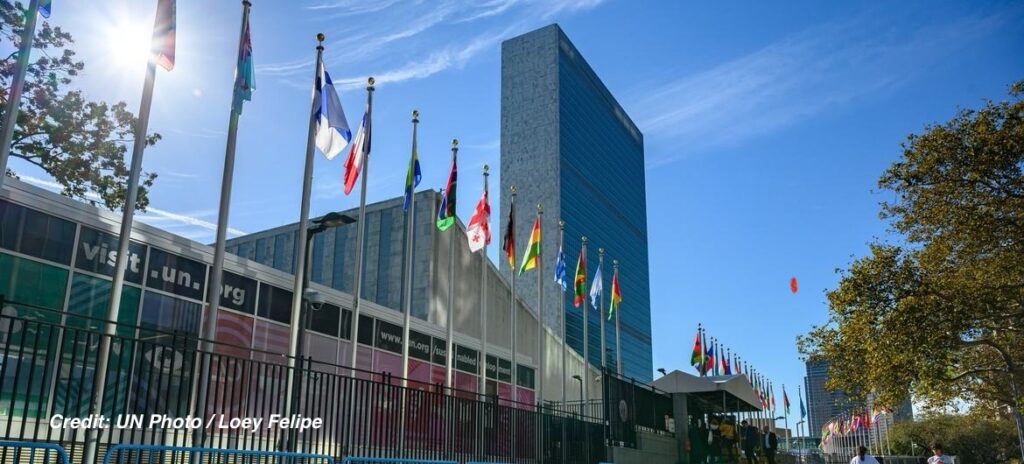
New York, 18 September 2025 – The United Nations General Assembly will hold its 80th session (September 23-29) during which nearly 150 heads of state and government and dozens of high-ranking officials are to address the world’s current situation. UN Secretary General Antonio Guterres is urging those world leaders to take action to end crises – from wars and famine to climate change
“We are gathering in turbulent – even uncharted – waters,” he said ahead of the session. “Geo-political divides widening. Conflicts raging. Impunity escalating. Our planet overheating. New technologies racing ahead without guardrails. Inequalities widening by the hour. And international cooperation is straining under pressures unseen in our lifetimes.”
“But next week every country will be here – including nearly 150 Heads of State and Government. This is an opportunity we cannot miss.”
Guterres urged world leaders attending the annual session to “get serious and deliver” reminding them that the high-level meetings are known also as “the World Cup of diplomacy … but this cannot be about scoring points, It must be about solving problems.”
“The United Nations is the place. Next week is the time. Leaders must get serious,” he said.
UN announces cuts in budget and staff while damages inflicted on children’s education and health and needy people are palpable
Just before the 193 UN member members are to begin their annual meetings to celebrate the organization’s 80th anniversary, they are told of significant cuts in the budget for global activities and how the cuts would affect humanitarian and peacekeeping activities as well as personnel.
The UN chief said the revised regular annual budget for 2026 is estimated at $3,238.2 million after a reduction of nearly $577 million following an extensive review done in previous months by the UN Secretariat about how to implement its mandate and allocate the diminished resources. As for human resources, there will be a reduction of 2,691 posts and the estimated total number of UN posts in 2026 will be 11,594 – or a reduction of 18.8 per cent.
“While ensuring balance among the three pillars of our work – peace and security, human rights and sustainable development – Secretariat entities explored how to improve delivery to optimize the use of resources. As a result, we identified targeted efficiencies and cost reductions to the regular and support account budgets for 2026 – reductions of more than 15 per cent in the regular budget level and about 19 per cent in posts, compared to the approved levels for 2025,” Guterres said in a letter to UN state members.
He said the reductions have been “carefully calibrated” to shield programs and activities directly supporting member states, particularly least developed countries, landlocked developing countries and small island developing states, and advocacy for the development of Africa. Support for peacebuilding and resident coordinators will also remain.
The report on budget reductions has been sent to the Committee on Administrative and Budgetary Questions in the UN General Assembly for its consideration as part of the UN80 programs. The report is expected to be adopted by the membership to reform and improve efficiencies in the UN global programs despite funding cuts. UN members are expected to negotiate and decide on administrative and budget programs so they can take effect beginning of 2026.
In another letter to the UN staff, Guterres said the changes made in the budget and programs are expected to affect their daily work and professional lives. But he assured them: “You will be fully engaged and supported throughout the process.”
He said the changes are “not across-the-board reductions” because they maintain balance between the three pillars of the organization – peace and security, human rights and sustainable development.
Funding cuts have closed hundreds of humanitarian organizations –
Tom Fletcher, the head of the Office for the Coordination of Humanitarian Affairs (OCHA), said on 15 September that humanitarian programs are “underfunded, overstretched and under attack” since fundings are drastically reduced and his department has only 19 per cent of the funds needed in response to crises. The top donors to humanitarian programs have been the European Commission, the United States and the United Kingdom.
Fletcher pointed out that OCHA and the international community have been dealing with crises around the world, including the war in Ukraine and Gaza, and conflicts as well as humanitarian crises in Sudan, Syria, the Democratic Republic of Congo, Afghanistan, Haiti and Myanmar. OCHA and humanitarian partners had called for $44 billion to assist 180 million vulnerable people in 70 countries in 2025 but received under $15 billion.
Funding cuts have forced six million more children to stay out of school in 2025, the UN Children’s Fund said, and the UN High Commissioner for Refugees warned that 11 million refugees may no longer receive any help they need. (By J. Tuyet Nguyen)
United Nations journalists – United Nations journalists – United Nations journalists
United Nations News – United Nations News – UN Correspondents Association – UNCA Awards