


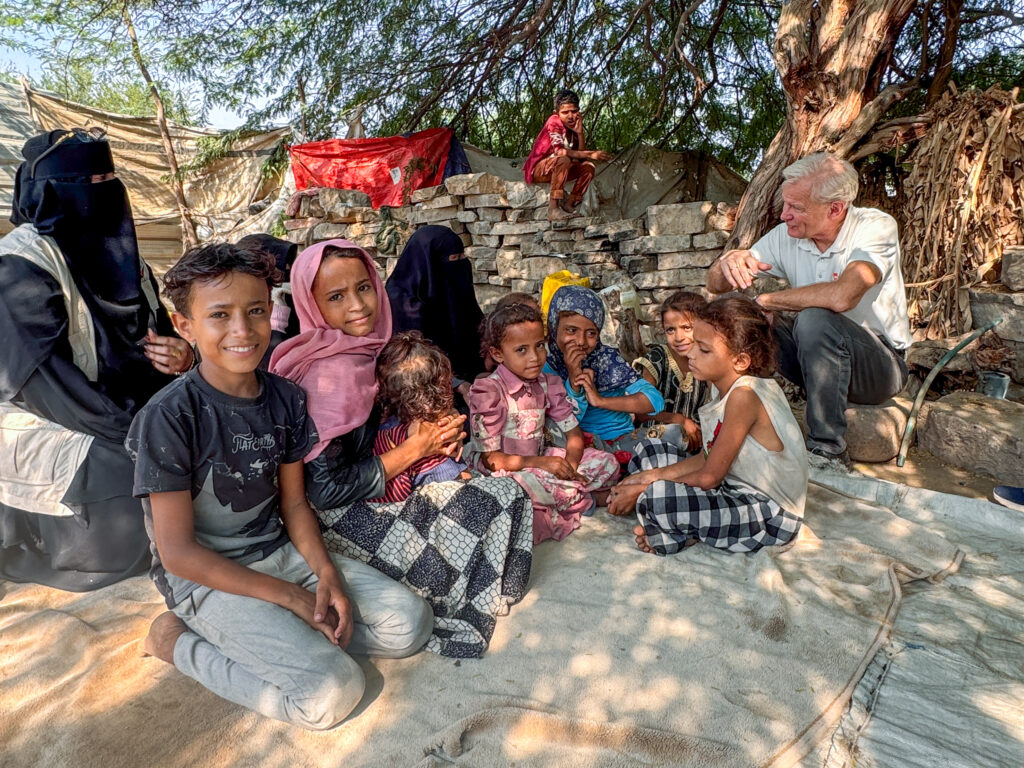
Note: The following press release from the Norwegian Refugee Council (NRC) is on the dire humanitarian crisis in Yemen, and the impact of the ongoing conflict on hundreds of thousands of newly displaced civilians. NRC Secretary General, Jan Egeland, is currently visiting the country. Please get in touch if you would like to arrange an interview.
Oslo, 25 November 2026 – Intensifying conflict is driving horrific levels of harm and deepening humanitarian needs across Yemen, warned Jan Egeland, Secretary General of the Norwegian Refugee Council (NRC), during a visit to the country this week.
Yemen entered this year as one of the most profound and most neglected humanitarian crises. Renewed fighting and airstrikes along multiple frontlines have uprooted hundreds of thousands of people. Despite shocking levels of suffering, the international response has withered, and conflict and civilian harm continues unabated.
In the north, home to most of the country’s population, a handful of overstretched and underfunded national and international organisations are the only remaining lifeline to millions in need. Severe funding reductions, sanctions, and the UN’s ongoing pause in its operations following detention of their aid workers have all contributed to a collapsing humanitarian response, compounded by the insecurity and access constraints.
“The situation across the country was already catastrophic, with long-term displacement and long-term humanitarian needs growing almost entirely out of sight,” said Egeland. “But now fighting has again displaced entire communities, while disrupted supply routes have driven up food and fuel prices. Across the country, families who were already struggling to survive are being pushed deeper into hunger.”
Yemen’s humanitarian response faces a severe lack of funding, which can be measured by the hundreds of thousands of families who will receive no support despite being in desperate need. Just 12 per cent of funding for emergency shelter support has been received so far, drastically reducing the ability of organisations to provide any shelter support to displaced people.
“Everywhere I have been, there are people searching for food or water, children are out of school, and parents desperately worrying about how to keep their children safe. I’ve met newly displaced people forced to shelter under the leaves of banana trees propped up with sticks,” said Egeland. “I’ve seen many families receiving no aid at all, while our courageous humanitarian colleagues struggle to increase emergency relief as well as minimal services for people who have remain displaced for years.
“All parties to the conflict bear responsibility for the vast scale of harm here. All must commit, in full, to protecting civilians and facilitating a humanitarian response at the scale that Yemenis need. The powerful countries backing the armed actors must commit to making this a reality.
“Across Yemen, I’ve been meeting with NRC teams and other humanitarians who are simply desperate to do more, but conflict and access restrictions, and the lack of funding, are preventing us from meeting even the most urgent needs. The suffering caused by cruel violence in Yemen is compounded by diplomatic and funding negligence of the highest order,” said Egeland.
Notes to editors:
- Photos from Egeland’s visit are available for free use here.
- 321,000 people have been displaced in Yemen since the escalation broke out in August (OCHA).
- Yemen’s 2026 humanitarian response is 23 per cent funded at 500.8 million US dollars out of 2.16 billion required (OCHA).
- In 2023 Yemen received 1.77 billion US dollars, approximately 41% of the 4.3 billion US dollars required to assist 17.3 million people. By November 2026, only 500 million US dollars had been secured – 23% of the 2.16 billion US dollars required. This is a 72 per cent decline in funding against increasing needs (OCHA).
- 23.1 million people across Yemen are in need of lifesaving humanitarian assistance, representing more than 65 per cent of the entire population (OCHA).
- 18.3 million people in Yemen face food insecurity (WFP).
- Since the escalation in August, 4,998 families have newly arrived at NRC-supported sites including 1,350 new families in Taiz, 3,130 new households in Abyan, and 518 new families in Lahj.
- The 2026 Humanitarian Needs and Response Plan aimed, before the escalation, to reach a much-reduced target of 12 million people, even while 22 million people require assistance(HNRP). Just 16 per cent of the funding required to support food security has been received, 22 per cent for WASH, and just 12 per cent for shelter, substantially limiting assistance to vulnerable communities (OCHA).
- Yemen featured 4th on NRC’s annual list of the world’s most neglected displacement crises this year (NRC).
- NRC supports 25 displacement sites for internally displaced persons (IDPs) in governorates hosting people fleeing the current fighting in Taiz governorate and the West Coast.
For more information and to arrange interviews:
- Ed Prior
Media Adviser to the Secretary General
Mobile: +47 902 94379 | ed.prior@nrc.no
Norwegian Refugee Council
www.nrc.no | Facebook | Twitter - NRC global media hotline, media@nrc.no, +47 905 62 329
United Nations correspondent journalists – United Nations correspondent journalists – United Nations journalism articles – United Nations journalism articles