Author name: admin

J. Tuyet Nguyen, a journalist with years of experience, has covered major stories in New York City and the United Nations for United Press International, the German Press Agency dpa and various newspapers. His reports focused mostly on topics with international interests for readers worldwide. He was president of the United Nations Correspondents Association (2007 and 2008), which is composed of more than 250 journalists representing world media with influence over policy decision makers. He has chaired the organization of the annual UNCA Awards, which seeks to reward journalists around the world who have done the best broadcasts and written reports on the UN and its specialized agencies. He has traveled the world to cover events and write stories, from politics to the environment as well cultures of different regions. But his most important reporting work has been with the United Nations since the early 1980s. He was bureau chief of United Press International office at the UN headquarters before joining dpa in 1997. Prior to working at the UN, he was an editor on the International Desk of UPI World Headquarters in New York. He worked in Los Angeles and covered the final months of war in Vietnam for UPI.

Global funding cuts could force 6 million more children out of school in the coming year – UNICEF

Note: Education funding faces US$3.2 billion decline by 2026, placing millions of children’s futures at risk. Following is a press release from the United Nations Children’s Fund (UNICEF).

New York, 3 September 2025 – As global education funding faces steep cuts, an estimated 6 million additional children could be out of school by the end of 2026, around one-third of them in humanitarian settings, UNICEF warned in a new analysis released today.

Official Development Assistance (ODA) for education is projected to fall by US$3.2 billion – a 24 per cent drop from 2023 – with just three donor governments accounting for nearly 80 per cent of the cuts. Such a decline would push the number of out-of-school children worldwide from 272 million to 278 million – the equivalent of emptying every primary school in Germany and Italy combined.

“Every dollar cut from education is not just a budgetary decision, it’s a child’s future hanging in the balance,” said UNICEF Executive Director Catherine Russell. “Education, especially in emergency settings, often serves as a lifeline, connecting children to essential services like health, protection, and nutrition. It also provides the strongest opportunity for a child to escape poverty and build a better life.”

According to the analysis, West and Central Africa faces the sharpest impact, with 1.9 million children at risk of losing out, while the Middle East and North Africa could see an increase of 1.4 million out-of-school children, alongside major rollbacks in all other regions.

The analysis finds that 28 countries are projected to lose at least a quarter of the education assistance they rely on for pre-primary, primary, and secondary schooling. Among them, Côte d’Ivoire and Mali face some of the greatest risks, with enrolment at risk of declining by 4 per cent – equivalent to 340,000 and 180,000 students, respectively.

Primary education is expected to be hit hardest around the world, with funding set to fall by a third – deepening the learning crisis and putting affected children at risk of losing an estimated US$164 billion in lifetime earnings.

In humanitarian settings, where education goes beyond learning, offering life-saving support, stability, and a sense of normalcy for traumatized children, funding could drop sharply – in some cases, cutting the equivalent of at least 10 per cent of the national education budget. For example, in UNICEF’s Rohingya refugee response, 350,000 children risk losing access to basic education permanently. Without urgent funding, education centres may close, leaving children vulnerable to exploitation, child labour, and trafficking.

Essential services such as school feeding programmes, sometimes a child’s only nutritious meal of the day, could see funding slashed by more than half, while support for girls’ education is also set to decline significantly.

Wide cuts at the system level will also undermine governments’ ability to make evidence-based plans, adequately support teacher development, and monitor learning outcomes. This means that even children who remain in school could see their learning suffer, with at least 290 million students across all regions projected to face a decline in education quality.

UNICEF urges donor and partner countries to act now to protect education by:

·       Rebalancing education assistance to be more equitable and effective with a minimum of 50 per cent directed to least developed countries;
 

·       Safeguarding humanitarian education funding and prioritizing education as a lifesaving intervention alongside other essential services;
 

·       Focusing education assistance on foundational learning, concentrating on early childhood and primary education where the returns are the highest;
 

·       Simplifying global financing architecture in line with the UN80 Initiative to improve efficiencies;
 

·       Expanding innovative financing without replacing core funding to education.

“Investing in children’s education is one of the best investments in the future – for everyone,” said Russell. “Countries do better when their children are educated and healthy, and it contributes to a more stable and prosperous world.”

#####

Notes to editors:

The projections are based on data from the OECD Creditor Reporting System (CRS, 2023 – the latest available year) and DonorTracker (July 2025). Public donor statements and policy documents were used to identify where education budgets are being reduced, with proportional cuts assumed for others. The estimate of additional children at risk of dropping out focuses on low- and lower-middle-income countries where education aid for primary and secondary schooling is projected to fall by 25 per cent or more. It assumes that cuts of this scale cannot be absorbed quickly by governments. In countries where dropout rates had already stalled, the impact would be felt more in the quality of education than in school attendance in the coming year.

Download multimedia content here. (Please reach out if you’re looking for b-roll, which will be available in a couple of hours).
Read the 2-pager brief and more on the methodology here.

About UNICEF 

UNICEF, the United Nations agency for children, works to protect the rights of every child, everywhere, especially the most disadvantaged children and in the toughest places to reach. Across more than 190 countries and territories, we do whatever it takes to help children survive, thrive, and fulfil their potential. 

For more information about UNICEF and its work, please visit: www.unicef.org  

Follow UNICEF on X (Twitter)FacebookInstagram, and YouTube 

For more information, please contact:  

Sara Alhattab | UNICEF New York | +1 917 957 6536 | salhattab@unicef.org
Nadia Samie-Jacobs | UNICEF New York | +1 845 760 2615| nsamie@unicef.org

United Nations journalists – United Nations journalists – United Nations journalists

United Nations News – United Nations News – UN Correspondents Association – UNCA Awards 

Global funding cuts could force 6 million more children out of school in the coming year – UNICEF Read More »

Gaza: Israel’s military assault on famine-stricken Gaza City will lead to countless deaths

Note: The Norwegian Refugee Council (NRC) warns about the grave consequences for civilians if Israel’s expanded military operation in Gaza City continues. Civilians already weakened by hunger and repeated displacements cannot withstand further bombardment. A UN-backed study by the Integrated Food Security Phase Classification (IPC) has confirmed that more than 600,000 people in Gaza are trapped in famine. Following is a press release from the NRC.

Oslo, 22 August 2025 – The Norwegian Refugee Council (NRC) warns that Israel’s expanded military operations in Gaza City will cause mass civilian deaths and intensify famine amid the collapse of humanitarian access. Civilians already weakened by hunger and repeated displacements cannot withstand further bombardment.

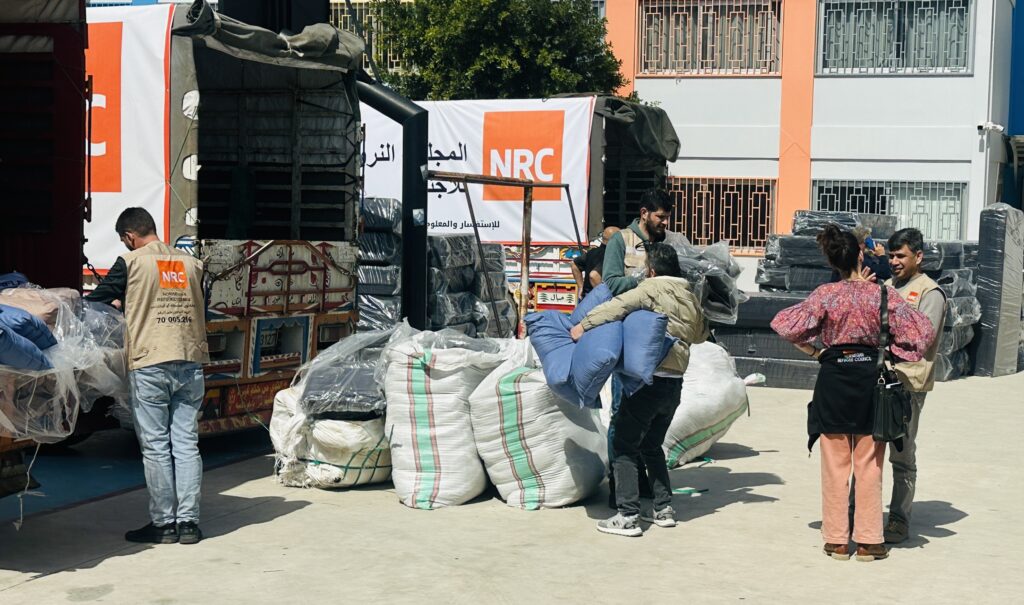
The spread of famine in Gaza City is compounded by growing needs caused by Israel’s systematic blocking of humanitarian aid. NRC and countless other aid groups have been blocked from bringing in any aid since March. Families are living under bombardment, while being intentionally deprived of the essentials needed for survival — food, clean water, medicine, and shelter — which sit waiting to enter mere kilometres away.

“Engineered scarcity has created a man-made famine. The people of Gaza are not only being bombed and displaced, but they are also being starved,” said Jan Egeland, Secretary General of the Norwegian Refugee Council. 

“In Syria, the Security Council created a way for aid to reach besieged communities. In Gaza, under occupation, Israel has a duty to allow relief but aid remains blocked. States must use their political and diplomatic weight to break the obstruction and get aid to civilians. Gaza’s children go without food or safety and their mothers ask which will come first, bombardment or starvation.”

Israel must abandon its intensified assault in northern Gaza, immediately allow a surge of all relief items, and allow all aid groups working in Gaza to reach civilians wherever they are, including Gaza and North Gaza governorates. 

“People are exhausted and fearful, caught between staying in Gaza City and fleeing south. Both choices are terrifying, and no one knows what to do,” said Salma Altaweel, NRC’s Northern Gaza Office Manager.

An estimated 86.3 per cent of Gaza falls within Israeli-designated militarized zones, areas under relocation directives or both. Displacement sites are at breaking point, forcing families into unsafe and undignified conditions.

While Israel has permitted the entry of limited quantities of commercial goods into Gaza in recent weeks, this is far from sufficient to reverse the spread of famine. 

“There will be a damning historical verdict on global leaders who confine themselves to express ‘concern’ as civilians in Gaza are bombarded, displaced, and starved,” Egeland continued. “An immediate ceasefire is the only way to stop the killing, secure the release of all hostages, and allow the massive humanitarian response needed to save lives.”

Notes to Editors: 

On 22 August, the Integrated Food Security Phase Classification (IPC) confirmed that there is a famine in Gaza City and warned that without immediate action famine could spread to other parts of the Gaza Strip. 

The NRC-led Shelter Cluster estimates that 1.4 million people require emergency shelter items and 1.45 million need essential household items. More than one million tarpaulins and sealing-off kits, 86,000 tents and about five million non-food items have been procured or in-process for delivery to Gaza. Ongoing restrictions on INGOs and UNRWA continue to block shelter deliveries, with critical materials denied entry even after approval. Following the announcement by the Israeli authorities that the ban on the entry of shelter supplies would be lifted, humanitarian agencies continue to face major challenges, including in relation to registration. 

According to OCHA, Israel began allowing limited amounts of commercial goods into Gaza on 4 August.  

According to the OCHA, an estimated 86.3 per cent of Gaza falls within Israeli-designated militarised zones, areas under relocation directives or both.  

Israel continues to obstruct the operations of international NGOs by rejecting requests to bring in lifesaving aid to Gaza and requiring organisations to submit to new registration rules, under which registration can be denied on the basis of vague and politicised criteria, such as alleged “delegitimisation” of the state of Israel.  

Media contact: Ed Prior, Media Adviser to the Secretary General

Advocacy and Media Section, Norwegian Refugee Council,

Oslo. Mobile: +47 902 94379 | ed.prior@nrc.no 

For information or to arrange an interview, please contact: 

NRC global media hotline: media@nrc.no, +47 905 62 329 

United Nations correspondent journalists – United Nations correspondent journalists – United Nations journalism articles – United Nations journalism articles – United Nations News – UNCA Awards 

Gaza: Israel’s military assault on famine-stricken Gaza City will lead to countless deaths Read More »

New Study: Data from Eight Countries Offers First Real-World Assessment of Plastic Pollution in Rivers — Finds Two-Thirds of River Trash is Plastic

Note: Amid the global plastic treaty negotiations, a new study of rivers in eight countries in Latin America, the Caribbean, Southeast Asia and Africa unveils largest dataset ever collected on plastic pollution in rivers; predicts 1.95 million metric tons of plastic — the weight of 5.3 Empire State buildings — travels down rivers worldwide every year. Following is a news release of the study.

Santa Barbara, California, 8 August 2025 – A sweeping new study in the Journal of Environmental Management has amassed the largest-ever continuous dataset on plastic pollution in rivers globally, classifying 66% of the debris analyzed as macroplastic — or large, visible pieces of plastic like bottles, bags, straws and cutlery. Whereas much plastic pollution research relies on models and estimates to make their conclusions, this dataset draws on an unparalleled, locally-led global effort to count trash found in rivers.

“We know that rivers worldwide are clogged with plastic — and that this plastic often ends up in the ocean. Researchers have provided large-scale modeling to show how this plastic travels from land to rivers to the ocean. This is the first on-the-ground data that helps shed light on why plastic is showing up in rivers in the first place,” said Chase Brewster, the lead author of the study and a project scientist in UCSB’s Benioff Ocean Science Laboratory. “Assessing macroplastic debris collected from eight diverse river systems across four continents: Insights from synchronous three-year community-led research effort.”

The research by experts at the University of California, Santa Barbara, used on-the-ground data from plastic-clogged rivers in Mexico, Jamaica, Panama, Ecuador, Kenya, Vietnam, Thailand and Indonesia. The study provides a valuable source of hard data on the scale of the plastic crisis amid negotiations this week at INC-5.2 in Geneva, Switzerland, to finalize an agreement to end plastic pollution.

“Negotiators and country officials can use this data to assess the river plastic pollution problem in real life, look at differences in pollution in different places, and test ideas about what policies and systems are working,” Brewster said.

Based on their study, researchers offer four key recommendations to help solve the plastic pollution problem:

1. Implement policies such as minimum recycled content, bottle deposit fees, and virgin production caps to create market conditions for a circular economy.

2. Support the informal waste-picking sector while investing in waste management and recycling infrastructure and services.

3. Conduct more consistent and more transparent monitoring and data collection to inform targeted upstream actions.

4. Pursue thoughtful, well-designed local and national policies as well as ambitious international frameworks to address the different scales of the problem.

To gather data, researchers worked with local partners to collect data from river sites between 2020 and 2023, with teams collectively removing and analyzing 3.8 million kilograms of river debris (equivalent to 380,000,000 single-use plastic water bottles). This large-scale, synchronous effort — rare in its scope and level of coordination — enabled researchers to compare data across diverse social, economic and environmental settings.

Researchers found substantial variation in the amount of plastic pollution intercepted in rivers studied, but all had plastic. Scaling up average plastic collection rates documented in this study would generate a preliminary estimate of 1.95 million metric tonnes (Mt) of plastic traveling down rivers worldwide every year. “That is an immense amount of plastic pollution,” said co-author and Director of the Benioff Ocean Science Laboratory, Professor Douglas McCauley.

Unique among many global pollution studies, the project took a community-led approach that emphasized local autonomy. Local nonprofits and social enterprises led the work in their own communities, sorting plastic waste by item type, polymer category, and other metrics. “Each site was an independent project,” Brewster explained. “They weren’t just collecting data. They were implementing technology to remove plastic from rivers, engaging governments, empowering communities, and improving local conditions.”

Together, these local teams form the Clean Currents Coalition, a global initiative directed by the Benioff Ocean Science Laboratory to intercept plastic before it reaches the ocean while fostering education and employment, restoring habitats, investing in local infrastructure, and cultivating systemic change. Since 2020, the Clean Currents Coalition has removed more than 7.3 million kilograms of debris (over 4.4 million kilograms of it plastic) from rivers worldwide.

“This work is really about turning off the tap of plastic pollution at its source,” Brewster added. “It’s not just cleaning rivers, it’s about doing purposeful science and supporting the communities that are the real leaders that will make this change last.”

For more information, please contact:
Chase Brewster (chasebrewster@ucsb.edu in Santa Barbara, California)
Rachel Bacal (rachelbacal@ucsb.edu in Santa Barbara, California)

United Nations journalists – United Nations journalists – United Nations journalists

United Nations News – United Nations News – UN Correspondents Association – UNCA Awards 

New Study: Data from Eight Countries Offers First Real-World Assessment of Plastic Pollution in Rivers — Finds Two-Thirds of River Trash is Plastic Read More »

Survey shows rise in war fears among Norwegians

Note: An annual survey on Norwegian views on peace and war under the current global situation shows that 59% of people surveyed believe in a new armed conflict in Europe within the next decade and 45% consider it likely that a new world war will break out within the next decade. More findings from the survey are available in the press release below.

Oslo, 5 August 2025 – Anxiety among Norwegians about the state of global peace and security continues to grow, according to a new survey released by the Peace Research Institute Oslo (PRIO).

The annual survey which gauges Norwegian attitudes toward war and peace, reveals that 59% of people questioned believe a new armed conflict in Europe is likely within the next decade, up from 55% last year. Similarly, 45% of respondents consider it likely that a new world war will break out withing 10 years, up from 41% in 2024. Almost 40% believe a nuclear attack somewhere in the world is likely in the next five years.

At the same time, concern about the erosion of global democratic values and the decline of international institutions is becoming more apparent. The survey finds that 62% of people believe democracy is in decline globally. Similarly, 64% agree that institutions such as the United Nations are less powerful than they once were.

While the concern over conflict globally and regionally remains high, Norwegians are also increasingly concerned about the country’s own security: 31% believe it is likely that Norway will experience armed conflict on its territory within the next decade (up from 26% in 2024), while 11% think it is likely that a nuclear attack against Norway will take place within the next five years.

The broader picture is one of growing global anxiety and declining trust in international institutions.

“A sense of foreboding about the future is growing among Norwegians. These findings paint a picture of a public increasingly attuned to global instability and skeptical about the capacity of institutions to manage it,” said Nina Græger, Director of PRIO. “This growing concern about international conflict and democratic backsliding will be central to our conversations at Arendalsuka festival next week, where PRIO is hosting three events to engage with the public and policymakers on the future of peace and security.”

PRIO will take part in Arendalsuka, Norway’s largest political gathering, with a series of events addressing the resilience of democratic institutions and the global backsliding of women’s rights, against a backdrop of geopolitical tensions and rightwing populism. “In these times of uncertainty and polarization, dialogue and evidence-based policy are more important than ever,” added Græger.

These Norwegian perceptions mirror a grim global reality. The world is witnessing a surge in violence unprecedented since the end of World War II. In 2024, the number of state-based armed conflicts reached its highest level in over 70 years. According to PRIO’s Conflict Trends: A Global Overview report, a staggering 61 conflicts erupted across 36 countries last year—underscoring a world order under immense strain.

For more information or to arrange an interview:

Contact Michelle Delaney, Communication Director at the Peace Research Institute Oslo (PRIO) | michelle@prio.org | mobile +47 941 65 579

For more information about PRIO’s events at Arendalsuka, visit our website here.

The survey was conducted by YouGov between 28 May and 2 June on a sample of 1,004 adults in Norway. The full survey data is available on request.

United Nations journalists – United Nations journalists – United Nations journalists

United Nations News – United Nations News – UN Correspondents Association – UNCA Awards 

Survey shows rise in war fears among Norwegians Read More »

UN calls for a world in which Israel and Palestine states coexist in peace to end conflict, deaths and starvation in Gaza

New York, 28 July 2025 – Diplomats met at the UN Headquarters to try to keep alive the decades-old resolution that called for an Israeli state and a Palestine state that can live in peace.

The three-day meeting in the UN General Assembly was chaired by Chaired by Jean-Noël Barrot, the Minister Foreign Affairs of France and Faisal bin Farhan Al Saud, Minister of Foreign Affairs of Saudi Arabia. The meeting is titled the High-Level International Conference for the Peaceful Settlement of the Question of Palestine and the Implementation of the Two-State Solution.

Israel and the United States have rejected the resolution. In Washington, the State Department spokesperson Tammy Bruce issued a statement that said, “The United States will not participate in this insult but will continue to lead real-world efforts to end the fighting and deliver a permanent peace. Our focus remains on serious diplomacy: not stage-managed conferences designed to manufacture the appearance of relevance.”

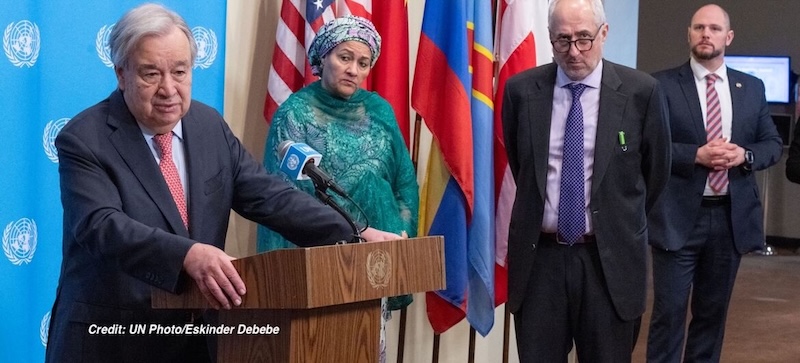
UN Secretary-General António Guterres opened the conference urging UN member states to take bold political action to salvage the two-state solution as negotiations have so far failed to produce a ceasefire to end the Israel-Hamas war that started on 7 October 2023.

“The truth is: we are at a breaking point. The two-state solution is farther than ever before,” the UN chief said. “We know that the Israeli-Palestinian conflict has endured for generations, defying hopes, defying diplomacy, defying countless resolutions, defying international law. But we also know its persistence is not inevitable. It can be resolved. That demands political will and courageous leadership, and it demands truth.”

“Unilateral actions that would forever undermine the two-State solution are unacceptable and they must stop,” Guterres said. “These are not isolated events. They are part of a systemic reality that is dismantling the building blocks of peace in the Middle East.”

France’s President Emmanuel Macron has publicly supported the two-state solution and said France will officially recognize the Palestinian state at the UN General Assembly annual session that will open in mid-September.

Barrot, the French foreign minister, said, “The European Commission, on behalf of the EU, has to express its expectations and show the means that we can incentivize the Israeli government to hear this appeal.”

Barrot said the conference in New York aimed at reversing “the trend of what is happening in the region — mainly the erasure of the two-state solution, which has been for a long time the only solution that can bring peace and security in the region.”

UN News reported that Mohammed Mustafa, Prime Minister of the State of Palestine, told the conference: “We have been waiting for long years for a genuine international intervention that would move us towards a peaceful, just and comprehensive solution to the Palestinian question. In this period of waiting, we have lost what we have lost, and we have suffered immensely.”

Mustafa said conference is “a turning point in which positions and declarations are translated into immediate and unprecedented practical steps to stop the genocide and end the Israeli occupation. The world must act to stop the aggression, starvation and displacement, and send a clear message: Enough disregard for the life and dignity of Palestinians — Palestinians are human beings.”

United Nations journalists – United Nations journalists – United Nations journalists

United Nations News – United Nations News – UN Correspondents Association – UNCA Awards 

UN calls for a world in which Israel and Palestine states coexist in peace to end conflict, deaths and starvation in Gaza Read More »

Humanitarian organizations warn mass starvation is spreading in Gaza

Note: A total of 115 humanitarian organizations warn that supplies are totally depleted in war-torn Gaza and aid workers as well as desperate Gazans seeking food risk their lives under the daily violence. The press release below signed by the organizations is found in https://reliefweb.int

New York, 23 July 2025 – As the Israeli government’s siege starves the people of Gaza, aid workers are now joining the same food lines, risking being shot just to feed their families. With supplies now totally depleted, humanitarian organisations are witnessing their own colleagues and partners waste away before their eyes.

Exactly two months since the Israeli government-controlled scheme, the Gaza Humanitarian Foundation, began operating, 109 organisations are sounding the alarm, urging governments to act: open all land crossings; restore the full flow of food, clean water, medical supplies, shelter items, and fuel through a principled, UN-led mechanism; end the siege, and agree to a ceasefire now.

“Each morning, the same question echoes across Gaza: will I eat today?” said one agency representative.

Massacres at food distribution sites in Gaza are occurring near-daily. As of July 13, the UN confirmed 875 Palestinians were killed while seeking food, 201 on aid routes and the rest at distribution points. Thousands more have been injured. Meanwhile, Israeli forces have forcibly displaced nearly two million exhausted Palestinians with the most recent mass displacement order issued on July 20, confining Palestinians to less than 12 per cent of Gaza. WFP warns that current conditions make operations untenable. The starvation of civilians as a method of warfare is a war crime.

Just outside Gaza, in warehouses – and even within Gaza itself – tons of food, clean water, medical supplies, shelter items and fuel sit untouched with humanitarian organisations blocked from accessing or delivering them. The Government of Israel’s restrictions, delays, and fragmentation under its total siege have created chaos, starvation, and death. An aid worker providing psychosocial support spoke of the devastating impact on children: “Children tell their parents they want to go to heaven, because at least heaven has food.”

Doctors report record rates of acute malnutrition, especially among children and older people. Illnesses like acute watery diarrhoea are spreading, markets are empty, waste is piling up, and adults are collapsing on the streets from hunger and dehydration. Distributions in Gaza average just 28 trucks a day, far from enough for over two million people, many of whom have gone weeks without assistance.

The UN-led humanitarian system has not failed, it has been prevented from functioning.

Humanitarian agencies have the capacity and supplies to respond at scale. But, with access denied, we are blocked from reaching those in need, including our own exhausted and starved teams. On July 10, the EU and Israel announced steps to scale up aid. But these promises of ‘progress’ ring hollow when there is no real change on the ground. Every day without a sustained flow means more people dying of preventable illnesses. Children starve while waiting for promises that never arrive.

Palestinians are trapped in a cycle of hope and heartbreak, waiting for assistance and ceasefires, only to wake up to worsening conditions. It is not just physical torment, but psychological. Survival is dangled like a mirage. The humanitarian system cannot run on false promises. Humanitarians cannot operate on shifting timelines or wait for political commitments that fail to deliver access.

Governments must stop waiting for permission to act. We cannot continue to hope that current arrangements will work. It is time to take decisive action: demand an immediate and permanent ceasefire; lift all bureaucratic and administrative restrictions; open all land crossings; ensure access to everyone in all of Gaza; reject military-controlled distribution models; restore a principled, UN-led humanitarian response and continue to fund principled and impartial humanitarian organisations. States must pursue concrete measures to end the siege, such as halting the transfer of weapons and ammunition.

Piecemeal arrangements and symbolic gestures, like airdrops or flawed aid deals, serve as a smokescreen for inaction. They cannot replace states’ legal and moral obligations to protect Palestinian civilians and ensure meaningful access at scale. States can and must save lives before there are none left to save.

United Nations journalists – United Nations journalists – United Nations journalists

United Nations News – United Nations News – UN Correspondents Association – UNCA Awards 

Humanitarian organizations warn mass starvation is spreading in Gaza Read More »

Fuel shortage in Gaza has reached critical levels, threatening lifelines for 2.1 million people, UN agencies warn

New York, 12 July 2025 – The United Nations Development Program (UNDP), speaking on behalf of five other UN agencies that are deeply committed to humanitarian assistance in Gaza, said fuel shortage in the enclave has reached a dangerous level that can starve the population there and close hospitals as well as other essential services.

UNDP, the World Food Program, the World Health Organization, the UN Funds for Population, UN Children’s Fund, the UN Office for Humanitarian

Affairs, the UN Office for Project Services and the UN agency for Palestinian Refugees (UNWRA) issued a joint statement as aid cuts and the on-going Israel-Hamas war have worsened the humanitarian conditions in Gaza.

The joint statement said, “Fuel is the backbone of survival in Gaza. It powers hospitals, water systems, sanitation networks, ambulances, and every aspect of humanitarian operations. Fuel supplies are needed to move the fleet used for transporting essential goods across the Strip and to operate a network of bakeries producing fresh bread for the affected population. Without fuel, these lifelines will vanish for 2.1 million people. 

After almost two years of war, people in Gaza are facing extreme hardships, including widespread food insecurity. When fuel runs out, it places an unbearable new burden on a population teetering on the edge of starvation. 

Without adequate fuel, UN agencies responding to this crisis will likely be forced to stop their operations entirely, directly impacting all essential services in Gaza. This means no health services, no clean water, and no capacity to deliver aid. 

Without adequate fuel, Gaza faces a collapse of humanitarian efforts. Hospitals are already going dark, maternity, neonatal and intensive care units are failing, and ambulances can no longer move. Roads and transport will remain blocked, trapping those in need. Telecommunications will shut down, crippling lifesaving coordination and cutting families off from critical information, and from one another.  

Without fuel, bakeries and community kitchens cannot operate. Water production and sanitation systems will shut down, leaving families without safe drinking water, while solid waste and sewage pile up in the streets. These conditions expose families to deadly disease outbreaks and push Gaza’s most vulnerable even closer to death. 

For the first time in 130 days, a small amount of fuel entered Gaza this week. This is a welcome development, but it is a small fraction of what is needed each day to keep daily life and critical aid operations running.

The United Nations agencies and humanitarian partners cannot overstate the urgency of this moment: fuel must be allowed into Gaza in sufficient quantities and consistently to sustain life-saving operations.” [Ends]

WFP says starvation is already “spreading” in Gaza

Carl Skau, the Deputy Executive Director of WFP, told the international media at UN Headquarters in New York on 11 July that his most recent visit to Gaza a week before showed that the situation has worsened.

“The humanitarian needs have never been higher, but also our ability to respond and to assist had never been more constrained. And let me begin with the situation. Starvation is spreading,” he said, adding that a study pointed out that the entire population is being acutely food insecure, and 500,000 people in starvation. “Since then, certainly it hasn’t gotten better. If anything, it’s much worse now. Malnutrition is surging.”

Skau cited a UNICEF report that said that 90,000 children now in the urgent need of treatment for malnutrition.

“One in three people in Gaza go for days without eating. I met many of those families who told me that there are days that their children are not eating at all, but the days where they are eating, it’s often a hot soup they get from us with just a few lentils or a few pieces of pasta, so certainly not enough. And I had mothers telling me how they’re trying to have kids not to play so that they don’t draw more energy than they’re able to provide them with through food.”

“I think it’s important to point to the displacement situation,” Skau said. “I’ve said before that I met families who have moved maybe two three times. Now it’s a situation where I meet families who have moved two three times in the past 10 days. They’ve moved 20 or 30 times, and obviously every time they are able to bring less and the margins to survive become slimmer. And the fact that people are now dying every day trying to get food is the starkest illustration of how desperate the situation is.” (By J. Tuyet Nguyen)

United Nations journalists – United Nations journalists – United Nations journalists

United Nations News – United Nations News – UN Correspondents Association – UNCA Awards 

Fuel shortage in Gaza has reached critical levels, threatening lifelines for 2.1 million people, UN agencies warn Read More »

Humanitarian response overstretched as more than 1 million Afghans return from Iran


Note: This press release relates to the massive returns from Iran to Afghanistan where over 22 million people are already in need of humanitarian assistance. Afghan families arrive exhausted and distressed to a country that has very limited capacity to reintegrate them and the humanitarian system is overstretched by the sheer pace and scale of arrivals, leaving many people without necessary support. Media contact: Tiril Skarstein, Head of Media Unit, Norwegian Refugee Council | Phone: +47 90569287 | Email: tiril.skarstein@nrc.no

Oslo, 10 July 2025 – Recent regional tensions and enforcement of deportation policies in Iran have triggered massive returns to Afghanistan overwhelming a humanitarian response already crippled by severe aid cuts and leaving needs unmet.  

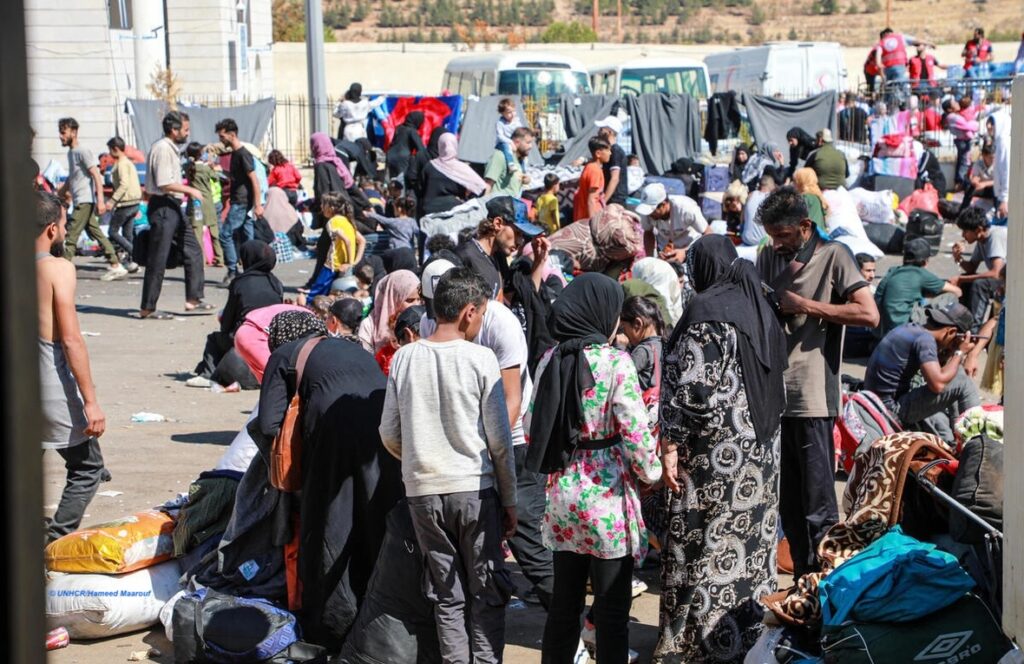
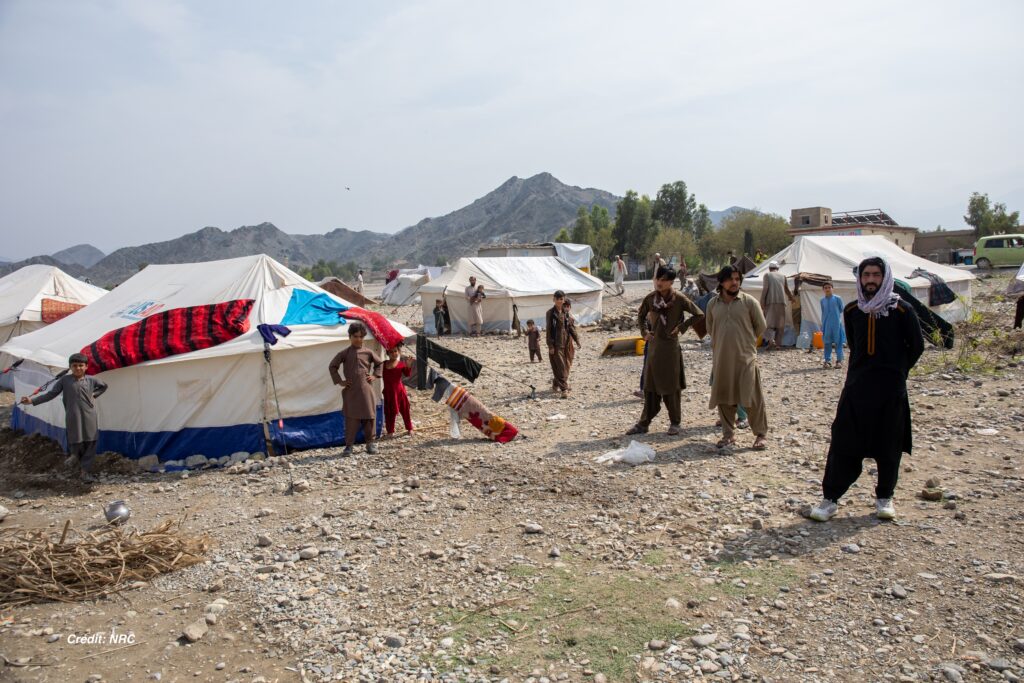
The Norwegian Refugee Council’s (NRC) teams in western Afghanistan report that the humanitarian system is overstretched by the sheer pace and scale of arrivals. More than 1.4 million people have returned to Afghanistan so far this year, including over 1 million people from Iran, and a large number from Pakistan. The daily number of returnees from Iran surged after 13 June, peaking on 1 July when over 43,000 people were registered in a single day, according to UNHCR. 

“We are seeing families arrive exhausted and distressed to a country that has very limited capacity to support and reintegrate them. We are doing everything we can, but the scale of needs is exceeding the current resources,” said Jacopo Caridi, NRC’s Country Director in Afghanistan.  

“Local communities have shown remarkable solidarity. Many of our staff are hosting returnee families in their homes. The authorities are doing their best to mobilize the few resources they have, but the local systems are not equipped to cope with such tremendous needs”. 

Many of the returnees have lived in Iran for decades, and some were even born there. They arrive with little to no belongings and are in urgent need of shelter, clean water, food, legal documentation, education, and healthcare.  

After decades of conflict and with two thirds of the population already in need of humanitarian support, Afghanistan faces extreme challenges in receiving and reintegrating large numbers of returnees, given the current limitations on public services and humanitarian support. 

“If current trends continue, Afghanistan could see over three million returnees by the end of 2025. The international community must not turn its back on Afghan civilians. Both returnees and host communities urgently need support to prevent further suffering and instability,” said Caridi.  

NRC also calls on all parties to uphold the principles of voluntary, safe and dignified return.  

“Involuntary returns should be halted as current conditions in Afghanistan do not meet the minimum standards for safety or sustainability. We also call for greater international responsibility-sharing and support for countries that have hosted Afghan refugees for decades,” said Caridi. 

Notes to editors: 

  • 1.4 million people have returned or been forced to return to Afghanistan so far this year (UNHCR).  
  • 22.9 million Afghans are already in need of humanitarian assistance (UN)
  • So far this year, donor countries have only provided 22 per cent of the money needed according to the humanitarian response plan (UNOCHA), and several donors have announced drastic funding cuts (NRC) .  
  • The regional refugee response plan is only 19 per cent covered (Refugee Funding Tracker).  
  • The underfunded displacement crisis in Iran is on NRC’s list of neglected displacement crises. Millions of Afghans have fled to Iran for protection, and Iran now hosts the largest refugee population globally (NRC). 
  • UNHCR’s non-return advisory for Afghanistan is available here.  

For more information or to arrange an interview, please contact: 

NRC global media hotline: media@nrc.no, +47 905 62 329 

Media contact: Tiril Skarstein, Head of Media Unit, Norwegian Refugee Council | Phone: +47 90569287 | Email: tiril.skarstein@nrc.no

United Nations journalists – United Nations journalists – United Nations journalists

United Nations News – United Nations News – UN Correspondents Association – UNCA Awards 

Humanitarian response overstretched as more than 1 million Afghans return from Iran Read More »

Humanitarian funding cuts leave millions without support

Note: The below press release from the Norwegian Refugee Council (NRC) highlights that halfway through 2025, funding cuts mean that just 6 billion US Dollars have been provided globally for the humanitarian response, two-thirds of the funding provided at this point last year, which itself was dramatically lower than the previous years. These cuts are costing lives and must be reversed.

Oslo, 1 July 2025 – Halfway through 2025, aid cuts by some of the world’s largest donors are having drastic consequences for the world’s most vulnerable, warns the Norwegian Refugee Council (NRC).

“Cuts in aid from major donors are close to crippling the humanitarian response in some of the world’s most dire displacement crises. It is hard to articulate the depth of donors’ abandonment. Compared to this point last year, just two-thirds of the humanitarian funding has been received, which itself was dramatically lower than the previous year,” said Jan Egeland, Secretary General of NRC. “These cuts are costing lives and must be reversed.”

As of the end of June, 6 billion US Dollars have been provided globally for the humanitarian response, down from 9 billion US Dollars at the same point in 2024. In total, 44 billion US Dollars has been requested for 2025.

Last month the United Nations announced a ‘hyper-prioritised’ plan to try and ensure the most vulnerable were able to receive support. This plan aims to reach 114 million of the 300 million people in need, with 29 billion US Dollars. This prioritisation leaves almost 200 million people who need assistance beyond the focus of the humanitarian response.

“Given the funding levels so far in 2025, even many of those targeted by the ‘hyper-prioritised’ plan are likely to be left with their needs unmet. Alongside traditional humanitarian donors, we need to see other step up to bridge this gap, including a wider group of donor countries and the private sector. Development actors, including development banks, must also step up their investments in fragile and conflict-affected countries so that displaced people and host communities can access the support they need,” said Egeland.

The consequences of aid cuts can be clearly seen across the world. In Mozambique, where Japan is so far this year’s largest humanitarian donor country, aid agencies are being forced to scale down their support due to the abrupt ending of their United States (US) funding.

“I witnessed first-hand the consequences in Mozambique, where I saw water tanks that can no longer be refilled due to the overnight cancellation of US funding. Families are left without a safe supply of drinking water. This is not only devastating lives but means that good investments already made with taxpayers’ money are getting lost. Our NRC teams too have been forced to scale down their support due to this halt in funding, and are now no longer able to provide safe housing for families made homeless by the recent cyclones. This is truly gut-wrenching,” said Egeland.

In Afghanistan, the US has drastically cut its aid work. Last year it supported 45 per cent of the humanitarian response in country.

“Our teams in Afghanistan remain on the ground and committed to the communities we have been working with for over two decades, but having lost our largest donor in the country our teams are being compelled to make heartbreaking choices on who and where we can help. We are not alone in this challenge. Many humanitarian organisations are being forced to reduce their support at a time when we are seeing more and more families returning to the country in need of urgent assistance,” said Egeland.

“This picture is being repeated time and time again around the world as international solidarity is being forced to cede to other priorities. Wealthy nations should step up funding before more lives are lost. If we can afford to host World Cups and global summits, and if NATO members can afford to increase defence spending to five per cent of GDP, we can afford to maintain support the most vulnerable in their hour of greatest need.”

Notes to editors: By 30 June 2025, a reported 5.96 billion USD had been delivered for the global humanitarian response (OCHA). That is down from 9 billion USD delivered at the same time last year (NRC). In total, 44.2 billion USD has been requested (OCHA).

In June the United Nations announced a ‘hyper-prioritised’ plan which aims to reach 114 million of the 300 million people in need, with 29 billion US Dollars (OCHA).

Four of the five lowest funded humanitarian (and needs) response plans for 2025 are in Latin America, all of which are less than 10% funded – Haiti (8.2%), Mali (8.5%), El Salvador (8.7%), Honduras (9%) and Venezuela (9.3%) (OCHA).

In Mozambique, Japan has provided 14.4 million USD to the 2025 humanitarian needs and response plan. 352 million USD is required. Overall, 17.4% of the plan has been funded to date (OCHA).

In 2024, the US provided 45% of the humanitarian funding for Afghanistan. The next largest donors were ECHO followed by the UK (12 and 10% of funding) (OCHA). 22% of the 2025 humanitarian needs and response plan is currently funded. While a notable portion of this is US funding no new US funding has been made available since January’s funding freeze was announced (OCHA).

Many major donors are cutting foreign aid budgets, which include both humanitarian and development funding. In January, the United States (US) suspended ongoing aid projects to conduct a foreign assistance review, forcing the majority of US-funded humanitarian work to be put on hold or, eventually, to cease (Devex). In February, the United Kingdom announced it would be cutting Overseas Development Assistance (ODA) from 0.5% to 0.3% of Gross National Income (UK Government). In February, the Dutch government also announced a EUR 2.4 billion cut in development aid from 2027 (Government of the Netherlands). The French government announced it would reduce public development assistance by more than EUR 2 billion – close to 40% of its annual funding (RFI). Swiss, Swedish, German and Belgian governments have also announced cuts in aid assistance budgets (DevexDevex, SwissInfoDevelopment Today).

NRC’s programmes funded by the United States have been greatly disrupted by the changing situation. While many of them have now been able to resume as they have been deemed lifesaving, the long-term picture remains very uncertain. NRC is still owed millions of US Dollars for already delivered programmes, including some outstanding payments from 2024. This uncertainty around payment is very disruptive to our ability to deliver.

For more information or to arrange an interview, please contact: NRC global media hotline: media@nrc.no, +47 905 62 329

United Nations journalists – United Nations journalists – United Nations journalists

United Nations News – United Nations News – UN Correspondents Association – UNCA Awards 

Humanitarian funding cuts leave millions without support Read More »

UN marks 80th anniversary with calls to make the organization more effective

New York, 26 June 2025 – The United Nations was established 80 years ago when countries that participated in the months-long San Francisco Conference adopted a charter while World War II was ending. The aging organization now needs significant reform to remain relevant.

The Charter of the United Nations, adopted by the original 50 countries that attended the conference led mostly by the World War II victors, says its primary determination is to “save succeeding generations from the scourge of war.” But hundreds of conflicts big and small have happened since the end of World War II in 1945. The world organization currently faces crises, wars, funding cuts, inequalities and mistrust, and division among member states.

UN Secretary-General Antonio Guterres acknowledged that the organization with 193 nations is facing times of difficulties and asked in his project UN80 Initiative launched in May: “How can we be the most effective Organization that we can be? How can we be more nimble, coordinated and fit to face the challenges of today, the next decade, and indeed the next 80 years?  The UN80 Initiative is anchored in answering these questions and equipping our organization in an era of extraordinary uncertainty.”

Guterres said the UN80 Initiative is structured around three key workstreams: “First, we are striving to rapidly identify efficiencies and improvements under current arrangements.  Second, we are reviewing the implementation of all mandates given to us by Member States. And third, we are undertaking consideration of the need for structural changes and program realignment across the UN system.”

Guy Ryder, the Under-Secretary-General for Policy and chair of the UN80 Task Force, said in an interview published by UN News: “This is a good time to take a look at ourselves and see how fit for purpose we are in a set of circumstances which, let’s be honest, are quite challenging for multilateralism and for the UN.”

UN News said the UN80 Initiative “seeks not only to improve efficiency, but also to reassert the value of multilateralism at a time when trust is low and needs are high. It aims to reinforce the UN’s capacity to respond to today’s global challenges – ranging from conflict, displacement, and inequality to climate shocks and rapid technological change – while also responding to external pressures such as shrinking budgets and growing political divisions in the multilateral space.”

“We will come out of this with a stronger, fit-for-purpose UN, ready for the challenges the future will undoubtedly bring us,” said Ryder.

“Yes, we do face financial challenges. No need to avert our eyes from that. But this is not a cost-cutting, downsizing exercise. We want to make the UN stronger,” he said.

UN News said the UN80 Initiative aims to modernize and streamline the UN system’s structure, priorities and operations to try to meet the challenges of our times. The initiative wields the potential to reinforce the Pact for the Future by focusing on the UN’s core strengths, fostering systemwide efficiencies, relocating staff to where needs are greatest and encouraging a new Grand Bargain to reinforce the multilateral system — reflecting renewed concerns about another Cold War or even a third world war, as well as environmental destruction, population growth and migration.

United Nations journalists – United Nations journalists – United Nations journalists

United Nations News – United Nations News – UN Correspondents Association – UNCA Awards 

UN marks 80th anniversary with calls to make the organization more effective Read More »